Category: Market Statistics

  • National Market Statistics Comparison: July 2025

    National Market Statistics Comparison: July 2025

    FAIRFAX, Va. (August 25, 2025) Housing activity in July highlighted how Northern Virginia’s market continues to differ from national patterns, according to the Northern Virginia Association of Realtors® (NVAR). While US sales and inventory expanded more broadly, Northern Virginia saw a modest dip in transactions but stronger price growth, highlighting the region’s continued appeal and competitiveness.

    “The national market is showing signs of cooling, but Northern Virginia’s market is better described as stabilizing,” said NVAR CEO Ryan McLaughlin. “We’re seeing more inventory and a modest slowdown in sales, but price growth and buyer activity remain stronger than the national picture. That balance keeps our region competitive even as conditions begin to normalize.”

    In July, Northern Virginia recorded 1,612 closed sales, a 1.6% decrease from July 2024. Nationally, however, sales moved in the opposite direction, with 4.01 million transactions, a 0.8% increase year-over-year. This divergence reflects the limited supply and higher price points that still define the local market.

    Price trends were even more telling. The median sold price in Northern Virginia climbed to $760,073, up 3.4% from last year, while the US median edged up only 0.2% to $422,400. Homebuyers in Northern Virginia continue to pay nearly double the national average, underscoring the region’s long-standing status as one of the country’s most competitive and desirable housing markets.

    The pace of the market also shows how local conditions differ. Northern Virginia homes averaged 20 days on the market in July, up 25% from last year. Nationally, homes stayed on the market longer — 28 days on average compared to 24 in 2024. While both markets saw days-on-market rise, the quicker turnover in Northern Virginia illustrates persistent buyer urgency even as conditions loosen slightly.

    “Homes are taking a little longer to sell than they did last year, but the demand is still there,” said NVAR Board Member Mary Bowen, Long & Foster Real Estate. “Buyers may have a bit more time to make decisions and, in some cases, add more negotiable terms to the offer, yet desirable properties continue to move quickly. For sellers, that means the market is still competitive, even if it’s showing early signs of stabilizing.”

    Inventory expanded significantly at both the local and national levels, but Northern Virginia’s growth was sharper. Active listings in the region rose 43.4% to 2,530 units, compared to a 15.7% national increase in total listings to 1.55 million homes — the highest US inventory since the 2020 lockdowns. This local surge is giving buyers more choice but still falls short of true balance.

    The difference between the national and local market becomes even clearer when measuring supply. In July, Northern Virginia recorded 1.9 months of supply — a 39.4% increase from last year but still well short of the level considered a balanced market. Nationally, supply ticked up to 4.6 months from 4 months in 2024, a figure that underscores just how much tighter conditions remain locally. Even with added inventory, Northern Virginia’s market is far more competitive than the US overall.

    “While inventory is beginning to open up in Northern Virginia, the reality is that demand continues to run ahead of supply, which is why prices remain elevated,” said McLaughlin. “Our region’s housing market stands out nationally because of the region’s steady population growth, strong demand fueled by world-class schools and universities, and the vibrancy of its urban centers. With new transit connections and continued investment in local communities, buyers see long-term value here, keeping competition high even as inventory inches upward.”

    BACKGROUND

    The Northern Virginia Association of Realtors® reports on home sales activity for Fairfax and Arlington counties, the cities of Alexandria, Fairfax, and Falls Church and the towns of Vienna, Herndon, and Clifton. Below are July 2025 regional home sales compared to July 2024 for Northern Virginia, with data derived from Bright MLS as of August 8, 2025 (total sales and listings may not include garage/parking spaces):

    • The number of closed sales in July 2025 was 1,612 units. This was down 1.6% compared to July 2024.  
    • The volume sold in July 2025 reached $1.41B, marking a 2.6% increase over July 2024.
    • The average sold price was $872,753, up 2.9% from July 2024.
    • The number of new pending sales in July 2025 increased to 1,459 units — a 2.8% increase compared to July 2024.  
    • The number of active listings in July 2025 surged to 2,530 units — a 43.4% increase, the largest year-over-year jump in the dataset.
    • Average days on market increased to 20 days — a 25% increase over the previous year.
    • The months of supply of inventory in July 2025 was 1.9. This was up 39.4% compared to July 2024.

    Read more about the NVAR regional housing market at nvar.com/Marketstats.

    NVAR Charts, Graphs, Social Media for June 2025 NVAR Housing Stats  

    July Housing Data: Click here.

    Regional Jurisdiction Infographic: Click here.

    NVAR Region Infographic: Click here.

    NVAR 2023 Housing Economic Impact Report: Click here.

    NVAR 2025 Mid-Year Housing Forecast Update: Click here.

    These links are accessible from the Market Stats page here: Click here.

    About NVAR

    The Northern Virginia Association of Realtors® (NVAR) serves as the voice of real estate in the Greater Northern Virginia Region. NVAR is dedicated to enhancing Realtor® success by delivering exceptional value, driving innovation, and impacting the industry. Headquartered in Fairfax, Virginia, NVAR supports its 12,000 members with essential resources, including industry education, advocacy, networking, and professional development opportunities. The Association is committed to promoting ethical practices and excellence in real estate. It advocates on behalf of homebuyers, sellers, renters, and commercial tenants who are directly affected by local, state, and federal policy decisions impacting affordability, property rights, and quality of life. NVAR strives to elevate the standards of the real estate industry and to contribute to the overall growth and prosperity of the Washington DC Metropolitan Area and beyond. nvar.com.

    Follow us on X: @nvar

    Visit us on Facebook: facebook.com/nvar.realestate 

    Join us on LinkedIn: NVAR

    Follow us on Instagram: @nvarofficial
  • Market Statistics: July 2025

    Market Statistics: July 2025

    Northern Virginia Housing Market Cools Slightly as Inventory Grows
    Sales volume and prices remain steady, but longer market times and rising supply reflect
    a more cautious buyer landscape


    FAIRFAX, Va. (August 12, 2025) The Northern Virginia housing market in July 2025 showed
    signs of moderation compared to the same period last year, according to the Northern Virginia
    Association of Realtors® (NVAR). While total sold dollar volume and median home prices saw
    modest increases year-over-year, growing inventory and extended days on market suggest
    shifting dynamics in how buyers and sellers are approaching today’s real estate environment.


    Total sold dollar volume reached just over $1.41 billion in July, up 2.6% from July 2024, and the
    number of units sold stood at 1,612 — a 1.6% decrease from the previous year. The region’s
    median sold price rose 3.4% year-over-year to $760,073, reflecting steady buyer interest — but
    at a more measured level than what was seen during the peak pandemic-era housing market.


    “We’re seeing a market that is recalibrating,” said NVAR CEO Ryan McLaughlin. “Buyers are
    still active, and the market remains strong, but at a more measured intensity than in recent
    years. This shift is influencing both prices and expectations for buyers and sellers alike.”


    The number of active listings rose sharply to 2,530 in July of this year, a 43.4% increase
    compared to July 2024. Months of supply also increased to 1.9, up 39.4% year-over-year,
    signaling a loosening of the inventory constraints that have defined much of the past few years.
    Meanwhile, the average days on market climbed to 20 days, a 25% increase, indicating that
    homes are sitting longer as buyers weigh their options.


    “After several years of tight inventory and rapid sales, what we’re seeing now is a more
    balanced environment,” McLaughlin added. “Demand remains strong, and today’s market
    rewards sellers who price strategically and stay attuned to buyer expectations.”


    The July data paints a picture of a market in transition. While the fundamentals remain relatively strong, with prices and overall volume holding steady, the increase in supply and shift in buyer behavior suggest a more tempered real estate climate heading into the fall.


    “This shift is a sign that the market is normalizing,” said NVAR President Casey Menish,
    Pearson Smith Realty. “Buyers are approaching their decisions more carefully, and sellers are
    adjusting to longer timelines and increased competition. We’re moving away from extremes, and that’s a healthy development for long-term market stability,” she said.

    Market Statistics: July 2025 - Image

    Market Statistics: July 2025 - Image

    Press ReleaseMarket Statistics: July 2025 - Image

    Home Sales ReportMarket Statistics: July 2025 - Image

  • National Market Statistics Comparison: June 2025

    Northern Virginia’s Housing Market Outpaces National Sales

    Inventory Remains Tighter than U.S. Despite Increase

    FAIRFAX, Va (July 24, 2025) While the national housing market showed little movement in June 2025, the Northern Virginia region experienced a marked increase in sales activity and available inventory, signaling early signs of market recalibration, though not without challenges, according to the Northern Virginia Association of Realtors (NVAR).

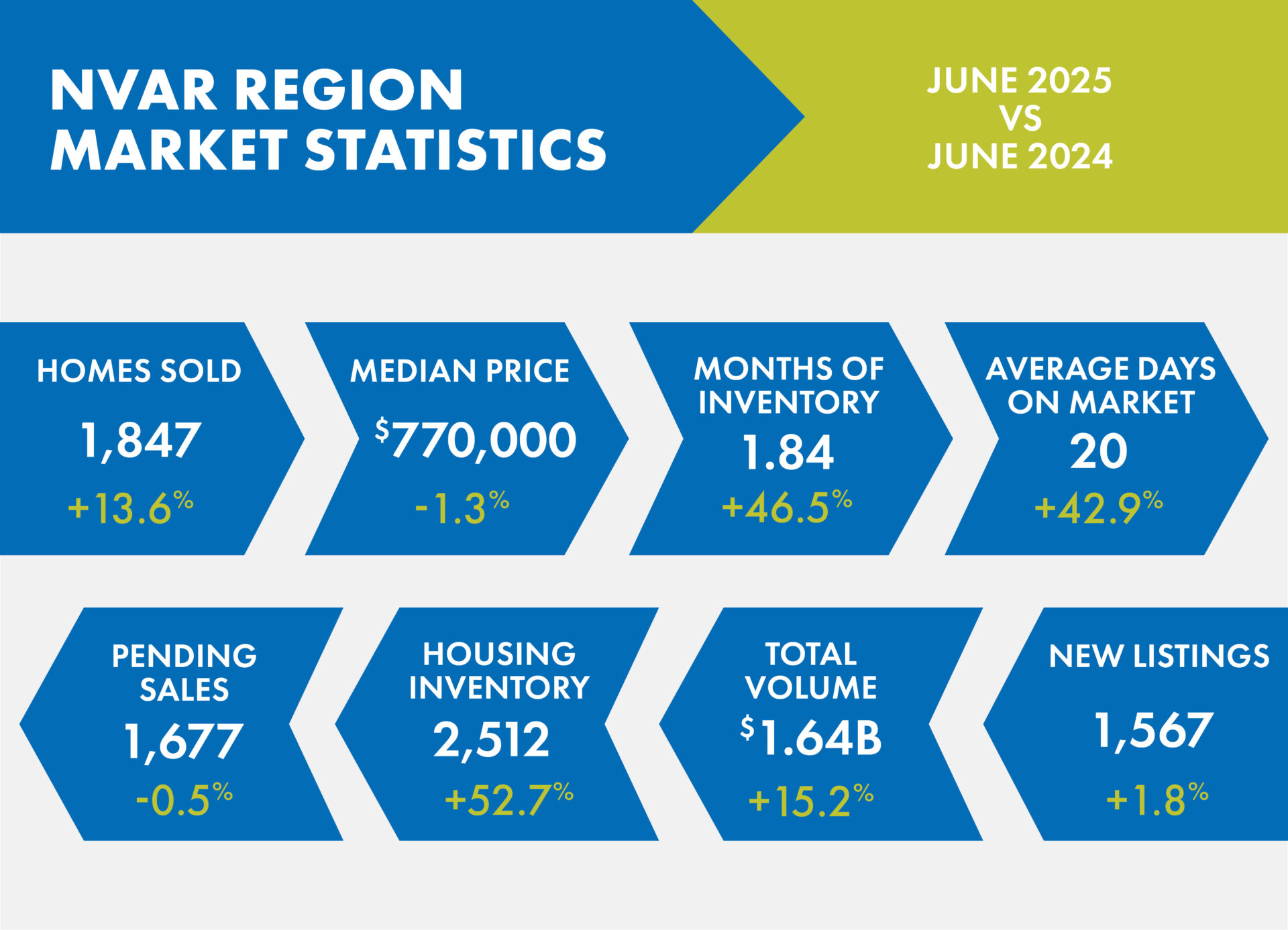
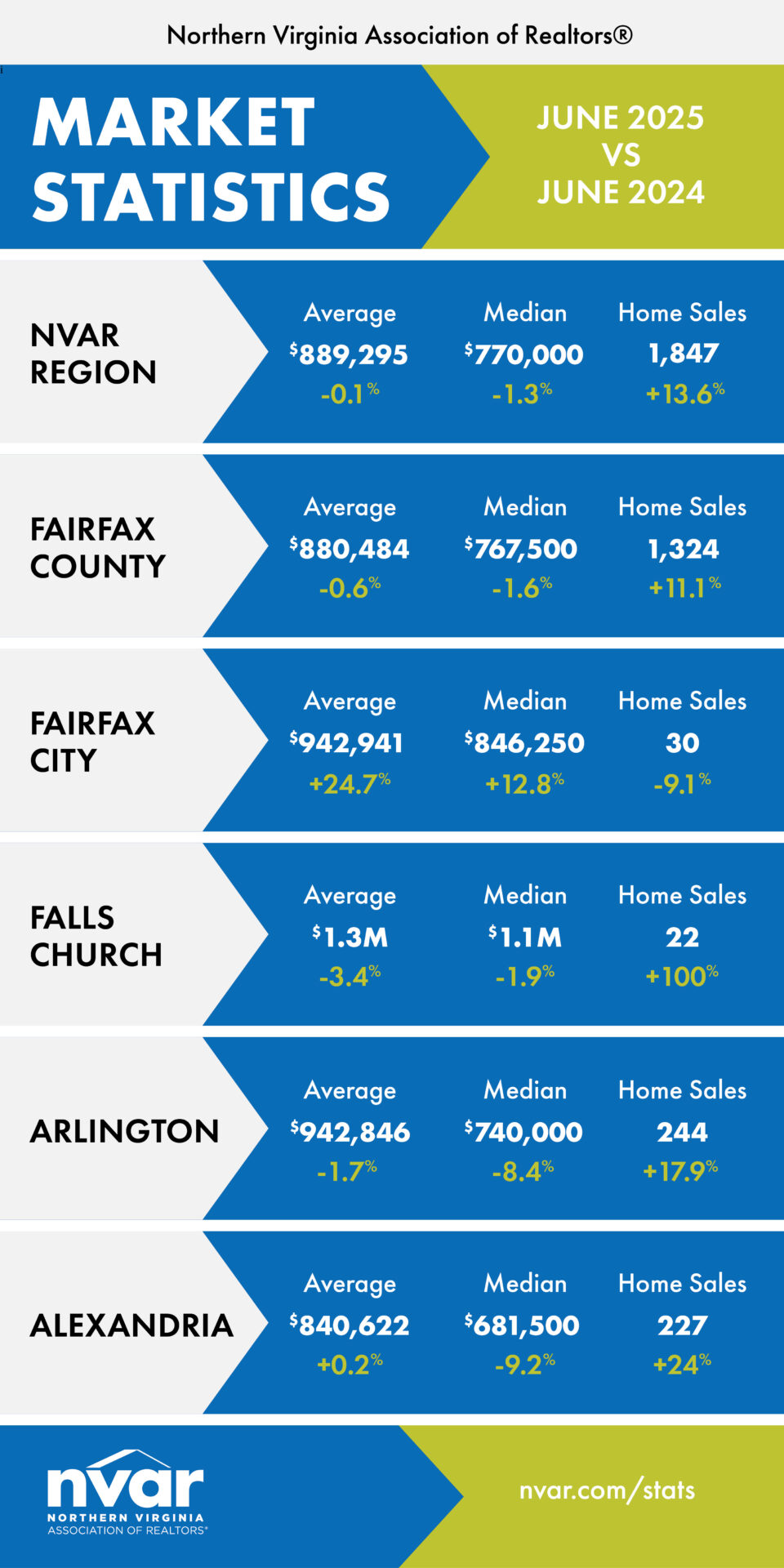
    Closed sales in Northern Virginia rose 13.6% year-over-year to 1,847 units in June, while national home sales held steady at 3.9 million units — showing no year-over-year change. The sharp contrast in growth rates underscores a more active recovery in the local market compared to the national landscape. This growth suggests renewed buyer activity in the region, likely fueled by more listings and less urgency to compete.

    “We’ve seen some pent-up demand begin to move in June, but buyers are proceeding with caution,” said NVAR CEO Ryan McLaughlin. “It’s a shift toward a more sustainable pace, as supply begins to catch up and pressure eases slightly.”

    Home prices in Northern Virginia dipped 1.3% year-over-year to a median of $770,000, while national prices climbed 2.0% to a record $435,300. The price drop in Northern Virginia, though modest, reflects market sensitivity in a high-cost region where affordability remains a concern.

    “Price trends in our region are a reflection of buyers reassessing what they can afford,” McLaughlin said. “We’re seeing some softening in pricing, particularly in segments that had accelerated rapidly in recent years, and that’s creating opportunities, though affordability is still a real barrier for many.”

    One of the clearest changes this June was the increase in housing supply. Active listings in Northern Virginia climbed 52.7% to 2,512 units compared to June 2024. Months of supply rose to 1.84, up 46.5% year-over-year. Nationally, inventory reached 4.7 months, a healthier level compared to 4.0 months a year ago. While Northern Virginia’s market remains tighter than the national average, the growth in supply is a welcome development.

    “It’s encouraging to see more listings coming online, but inventory remains below balanced levels,” said NVAR President-Elect Rob Carney, TTR Sotheby’s International Realty. “The upside is that buyers have more room to make thoughtful decisions. The downside is that affordability hasn’t fully caught up with what’s available.”

    Homes in Northern Virginia spent an average of 20 days on the market in June, an increase of 42.9% from last year. Nationally, the median days on market was 53, up 10.4%. Although homes in the Northern Virginia region still move relatively quickly, the uptick in time on market suggests buyers are taking a more cautious, strategic approach.

    “Sellers are adjusting to a slower timeline, and buyers are taking the time to evaluate their options,” said McLaughlin. “It’s a more balanced dynamic, but it’s still a challenging environment, especially for first-time buyers.”

    Northern Virginia’s housing market is not immune to national headwinds, but it is showing early signs of recovery — fueled by increased inventory and more realistic pricing. As the region moves through the second half of the year, improvement in affordability and supply will be key to sustaining momentum.

    BACKGROUND

    The Northern Virginia Association of Realtors® reports on home sales activity for Fairfax and Arlington counties, the cities of Alexandria, Fairfax, and Falls Church and the towns of Vienna, Herndon, and Clifton. Below are June 2025 regional home sales compared to June 2024 for Northern Virginia, with data derived from Bright MLS as of July 9, 2025 (total sales and listings may not include garage/parking spaces):

    • The number of closed sales in June 2025 was 1,847 units. This was a 13.6% increase compared to June 2024.  
    • The volume sold in June 2025 was $1,640,647,044. This was a 15.2% increase compared to June 2024.
    • The average sold price was $889,295 in June 2025. This was down 0.1% compared to June 2024.
    • The number of new pending sales in June 2025 was 1,677 units. This was down 0.5% from June 2024.  
    • The number of active listings in June 2025 was 2,512 units. This number was up 52.7% compared to June 2024.
    • The number of new listings in June 2025 was 1,567 units. This number was up 1.8% compared to June 2024.

    Read more about the NVAR regional housing market at nvar.com/Marketstats.

    NVAR Charts, Graphs, Social Media for June 2025 NVAR Housing Stats  

    June Housing Data: Click here.

    Regional Jurisdiction Infographic: Click here.

    NVAR Region Infographic: Click here.

    NVAR 2023 Housing Economic Impact Report: Click here.

    NVAR 2025 Mid-Year Housing Forecast Update: Click here.

    These links are accessible from the Market Stats page here: Click here.


    About NVAR

    The Northern Virginia Association of Realtors® (NVAR) serves as the voice of real estate in the Greater Northern Virginia Region. NVAR is dedicated to enhancing Realtor® success by delivering exceptional value, driving innovation, and impacting the industry. Headquartered in Fairfax, Virginia, NVAR supports its 12,000 members with essential resources, including industry education, advocacy, networking, and professional development opportunities. The Association is committed to promoting ethical practices and excellence in real estate. It advocates on behalf of homebuyers, sellers, renters, and commercial tenants who are directly affected by local, state, and federal policy decisions impacting affordability, property rights, and quality of life. NVAR strives to elevate the standards of the real estate industry and to contribute to the overall growth and prosperity of the Washington DC Metropolitan Area and beyond.

    Follow us on X: @nvar

    Visit us on Facebook: facebook.com/nvar.realestate 

    Join us on LinkedIn: NVAR

    Follow us on Instagram: nvarffx

    ###

  • Market Statistics: June 2025

    June Brings Stronger Sales and More Listings to Northern Virginia Housing Market
    Higher inventory and buyer activity shape a more balanced market
    FAIRFAX, Va. (July 14, 2025) Northern Virginia’s housing market showed renewed strength in June as a wave of new listings helped meet buyer demand and drive year-over-year gains in both home sales and total transaction volume, according to the Northern Virginia Association of Realtors® (NVAR). The number of homes sold in June 2025 climbed to 1,847 — a 13.6% increase over June 2024. As more transactions closed, total sold dollar volume reached more than $1.64 billion, marking a 15.2% gain from the previous year.


    Inventory was the key driver of this growth. Active listings jumped 52.7% year-over-year, reaching 2,512 properties on the market. This helped push the months of supply to 1.84, a 46.5% increase compared to June 2024, giving buyers more breathing room than in recent years.


    While buyer activity was strong, increased inventory also brought slight shifts in pricing and pace. The median sold price in June 2025 dipped 1.3% year-over-year to $770,000. Homes stayed on the market for an average of 20 days, a 42.9% increase from the previous year. Together, these trends point to a market that is normalizing — offering buyers more flexibility while encouraging sellers to align with evolving conditions.


    “We view this as a healthy recalibration,” said NVAR CEO Ryan McLaughlin. “Buyers have more time to make informed decisions. Pricing is stabilizing after years of intense upward pressure. These are all indicators of a maturing, resilient market that is adjusting to new conditions without losing momentum.”


    This summer, buyers in the region are taking a more measured approach, reflecting a transition toward a more balanced market environment. “The difference this year is options,” said NVAR Board Member Veronica Seva-Gonzalez, Compass. “Buyers aren’t rushing into the first available home; they’re able to take a breath, compare choices, and still act competitively when the right property comes along. It’s a more thoughtful market, and that’s good for everyone. While some markets have seen inventory improve, competition remains fierce in some of the most sought-after areas, where well-priced homes are still receiving multiple offers.”


    Looking ahead, NVAR anticipates steady market activity, particularly if more homeowners choose to list their properties. With conditions gradually balancing and opportunities expanding, the region is well-positioned for continued resilience in the months ahead.


    “Northern Virginia’s economic stability, excellent schools, and overall quality of life remain major draws,” McLaughlin said. “If more sellers enter the market, we anticipate strong performance across the region for the rest of the year.”

    Market Statistics: June 2025 - Image

    Market Statistics: June 2025 - Image

    Press ReleaseMarket Statistics: June 2025 - Image

    Home Sales ReportMarket Statistics: June 2025 - Image

  • National Market Statistics Comparison: May 2025

    Northern Virginia Housing Market Shows Mixed Signals, But Outpaces National Trends in Key Areas

    May home sales drop more steeply than national average, but prices and speed signal continued strength

    FAIRFAX, Va. (June 24, 2025) The Northern Virginia housing market showed steadfast resilience in May 2025, with home prices continuing to climb and properties selling far faster than the national average, says the Northern Virginia Association of Realtors® (NVAR). While national housing data signals a broader slowdown, Northern Virginia appears to be entering a more balanced but still competitive phase, with some signs of cooling alongside continued strengths.

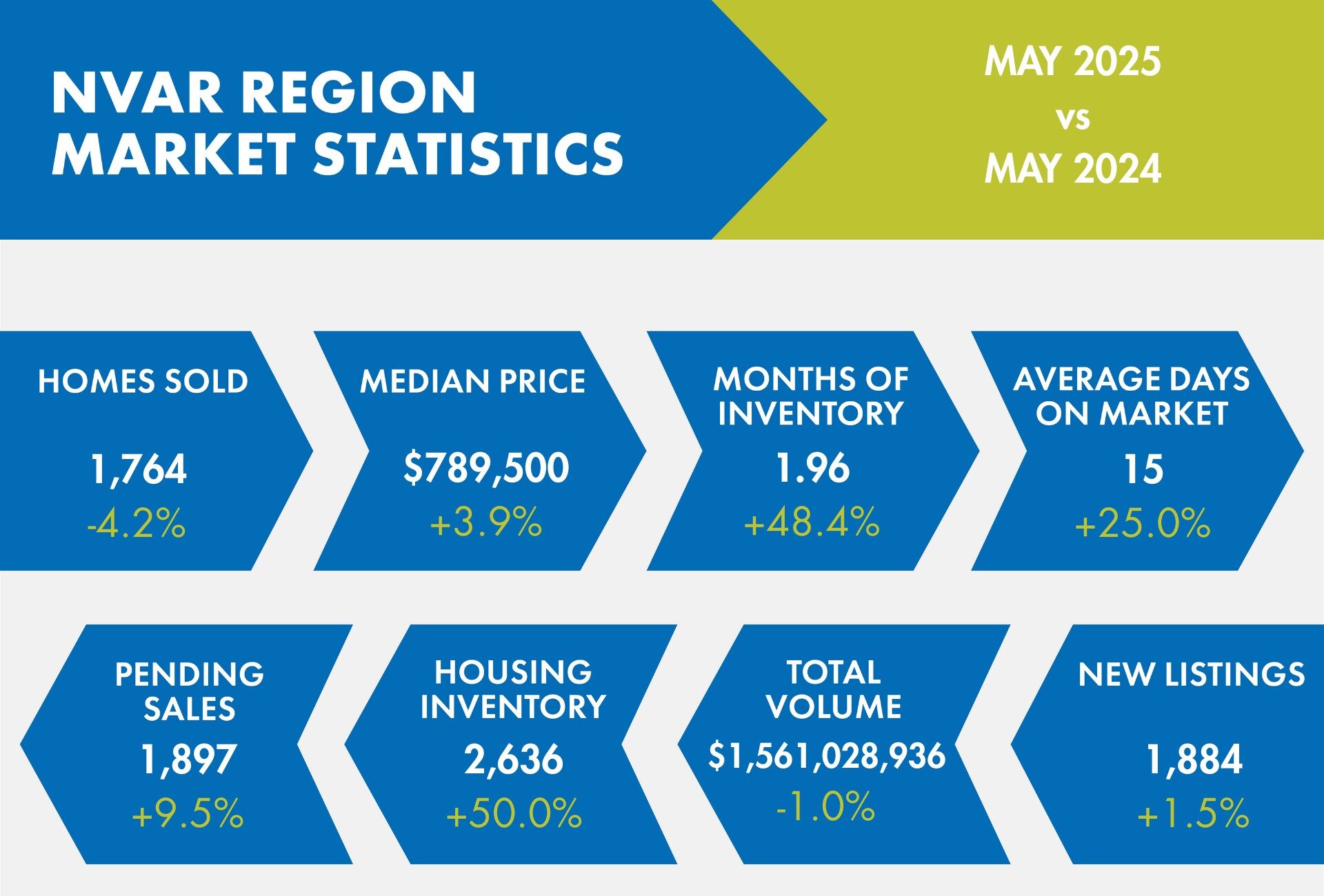
    Despite signs of resilience in pricing and pace, Northern Virginia is not immune to the broader housing slowdown. Closed sales in Northern Virginia totaled 1,764 units in May, a 4.2% drop compared to the same month last year. Nationally, existing-home sales declined by only 0.7% to 4.03 million units. While both markets are reacting to persistent affordability challenges and elevated interest rates, Northern Virginia’s price appreciation and brisk market pace suggest underlying strength.

    The median sold price in the region rose 3.9% to $789,500, compared to a 1.3% increase nationally, where the median price reached $422,800. In addition, homes in Northern Virginia sold in 15 days on average, nearly two weeks faster than the national average of 27 days.

    “The national housing story is one of increasing supply and slowing demand, but Northern Virginia continues to tell its own story,” said NVAR CEO Ryan McLaughlin. “Prices here are rising more steadily, and homes are moving faster than the national average. That speaks volumes about the long-term desirability of our region.”

    Inventory levels also highlight a divergence. While national housing supply increased to 4.6 months, Northern Virginia remained much tighter at 1.96 months of supply, despite a 50% year-over-year surge in active listings to 2,636 units. This inventory boost is providing more options for buyers but has not shifted the market fully away from sellers. The steep jump in inventory reflects growing seller confidence and signals that more homeowners are re-entering the market after holding off during peak interest rate volatility. However, the region’s strong demand is absorbing much of this new supply, keeping conditions competitive.

    “We’re seeing a much-needed increase in inventory, which is good news for buyers, but we’re not flooded with excess supply like some markets,” McLaughlin said. “Northern Virginia buyers still have to act decisively on the right homes. This isn’t a market of hesitations; it’s one of opportunities.”

    With more choices for buyers, continued price strength, and a pace well ahead of national averages, Northern Virginia remains one of the country’s most dynamic and resilient real estate markets. Competitively priced homes in sought-after neighborhoods continue to move quickly, underscoring the market’s durability even as conditions normalize.

    “As we head into the summer season, the Northern Virginia housing market is showing signs of maturity — not volatility,” McLaughlin added. “It’s more balanced than it was a year ago, and that’s healthy. Buyers and sellers are adjusting expectations and finding common ground.”


    BACKGROUND

    The Northern Virginia Association of Realtors® reports on home sales activity for Fairfax and Arlington counties, the cities of Alexandria, Fairfax, and Falls Church and the towns of Vienna, Herndon, and Clifton. Below is May 2025 regional home sales compared to May 2024 for Northern Virginia, with data derived from Bright MLS as of June 9, 2025 (total sales and listings may not include garage/parking spaces):

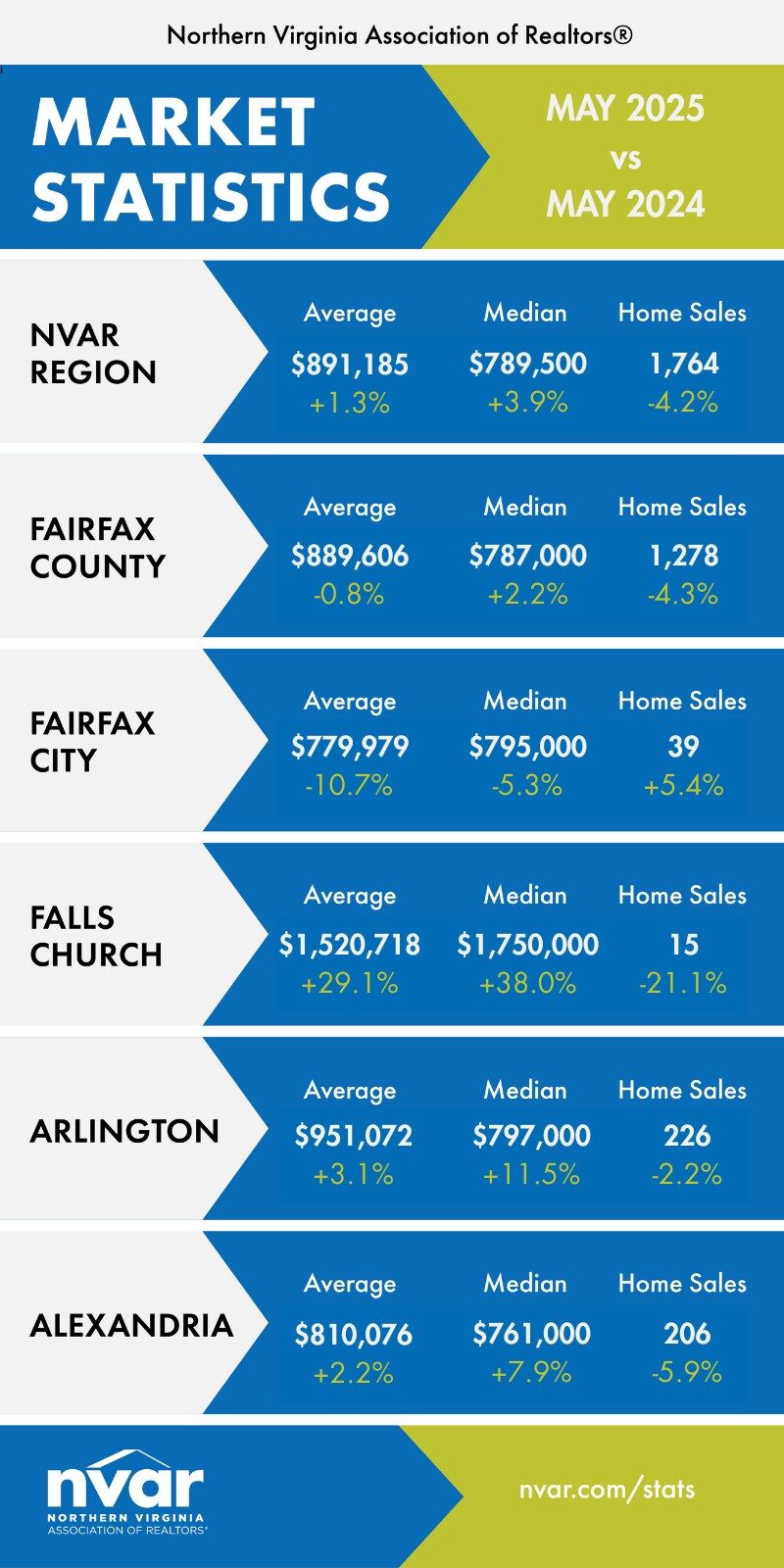
    • The number of closed sales in May 2025 was 1,764 units. This was a 4.2% decrease compared to May 2024.  
    • The volume sold in May 2025 was $1,561,028,936. This was a 1.0% decrease compared to May 2024.
    • The average sold price was $891,185 in May 2025. This was up 1.3% compared to May 2024.
    • The number of new pending sales in May 2025 was 1,897 units. This was up 9.5% compared to May 2024.  
    • The number of active listings in May 2025 was 2,636 units. This number was up 50.0% compared to May 2024.
    • The number of new listings in May 2025 was 1,884 units. This number was up 1.5% compared to May 2024.

    Read more about the NVAR regional housing market at nvar.com/Marketstats.

    NVAR Charts, Graphs, Social Media for May 2025 NVAR Housing Stats  

    May Housing Data: Click here.

    Regional Jurisdiction Infographic: Click here.

    NVAR Region Infographic: Click here.

    NVAR 2023 Housing Economic Impact Report: Click here.

    NVAR 2025 Housing Forecast Update: Click here.

    These links are accessible from the Market Stats page here: Click here.


    About NVAR

    The Northern Virginia Association of Realtors® (NVAR) serves as the voice of real estate in the Greater Northern Virginia Region. NVAR is dedicated to enhancing Realtor® success by delivering exceptional value, driving innovation, and impacting the industry. Headquartered in Fairfax, Virginia, NVAR supports its 12,000 members with essential resources, including industry education, advocacy, networking, and professional development opportunities. The Association is committed to promoting ethical practices and excellence in real estate. It advocates on behalf of homebuyers, sellers, renters, and commercial tenants who are directly affected by local, state, and federal policy decisions impacting affordability, property rights, and quality of life. NVAR strives to elevate the standards of the real estate industry and to contribute to the overall growth and prosperity of the Washington DC Metropolitan Area and beyond. nvar.com. 

    Follow us on X: @nvar

    Visit us on Facebook: facebook.com/nvar.realestate 

    Join us on LinkedIn: NVAR

    Follow us on Instagram: nvarffx

    ###

  • 2025 NVAR Mid-Year Regional Housing Market Forecast

    The Northern Virginia Association of Realtors® (NVAR), in partnership with the Center for Regional Analysis at George Mason University (GMU-CRA), issues a consensus forecast for the NVAR region’s housing market. The Association convenes a panel of experts from differing sectors of the real estate industry to review preliminary forecasts developed by GMU-CRA and offer insights into current and future market conditions. The following represents the forecast team’s mid-year update to the 2025 outlook.

    With the job market starting to reflect the policies of the new federal administration, the region’s housing market is approaching a transition period. Federal employment has declined by roughly 20,000 since December 2024, and job declines in the Professional, Scientific, and Technical Services subsector that began in early 2024 have accelerated due to spending cuts initiated by the Department of Government Efficiency (DOGE). In short, the two sectors that the DC metro region has historically relied on to underpin the housing market have been declining. Despite these substantial declines, however, total non-farm payrolls have continued to increase, led in no small part by a boom in construction jobs in Northern Virginia. Thus, while there are mixed signs about the region’s near-term economic prospects, there are signs of economic resilience that include the potential to see economic growth in emerging technology sectors and a housing market that remains solid. Still, the impacts of federal job cuts, the potential for agency relocation, and reduced federal contract spending in some sectors are driving uncertainty for businesses and residents of the region.

    Mortgage interest rates continue to challenge first time buyers; however, market participants appear to be acclimating to rates that look more like long run averages than the once-in-a-generation bargains seen during the COVID years. Market forecasters expect the Federal Reserve to lower benchmark rates by 50 basis points by year end. This means that mortgage rates may ease somewhat, but the forecast team expects 30-year fixed mortgage rates to remain in the mid-6% range.

    While uncertainty is the overarching theme of the region’s economy, the housing market looks set to become more balanced in supply and demand metrics, which is healthy compared to the past few years. Overall, the forecast for the Greater NVAR region calls for:

    • Modest sales price increases, generally between 2% to 2.5% month-over-year through the end of the year — more in line with overall inflation; and,
    • Stable or modestly increasing unit sales, particularly for detached single family properties in desirable neighborhoods; while,
    • Inventories will continue to rise through the end of the year for most regional markets and home types.

    While some inventory increases are forecast to be more than 70% month-over-year through the end of the year, the percent change represents relatively few homes and often reflect a return to market-normal conditions for Northern Virginia after periods of historically tight inventory. Given that Northern Virginia continues to be a desirable place to live, and there remains a lot of pent-up demand for for-sale housing, prices will continue to rise even as inventories increase. For some households not directly impacted by federal government uncertainties, this may be the best opportunity to purchase a home since before the pandemic. There is likely to be plenty of market activity for Northern Virginia Realtors® members.


    Forecast by Jurisdiction

    Fairfax County (view charts)

    The Fairfax County housing market is forecast to hold up throughout the second half of 2025. Median prices are forecast to increase more slowly than in the recent past, rising roughly 2.2% to 2.5% month-over-year on average between 2024 and 2025, with little variation among home types. Similarly, sales volumes are forecast to increase 0.0% to 1.6% month-over-year on average between 2024 and 2025, with sales of condos and townhomes slowing to be marginally positive. The most notable change is in inventory, which is forecast to increase between 52.0% and 79.5% month-over-year between 2024 and 2024, with more inventory building in townhomes (79.5%) and condos (73.9%) than single-family detached (52.0%). Overall, sales will remain steady as home prices trend back toward pre-pandemic growth rates and inventory levels normalize.


    Arlington County (view charts)

    In Arlington County, the housing market is forecast to be relatively solid for single-family detached and townhomes, with some weakness in the condo market. While median sales price is forecast to increase month-over-year from 2024 to 2025 by an average of 2.2% for Arlington single-family detached and 1.5% for townhomes, the median price of condos sold is forecast to decline by 4.9%. Sales of single-family detached homes are forecast to increase by a month-over-year average of 16.3% from 2024 to 2025, with townhome sales increasing an average of 2.2% month-over-year. In contrast, sales of condos are forecast to decrease a month-over-year average of 2.1% from 2024 to 2025. While the inventory of single-family homes is forecast to increase month-over-year 69.5% on average from 2024 to 2025, the total number of homes available remains a modest 167 in December. Townhomes inventory is forecast only to increase modestly, while condo inventory is forecast to increase to 236 in December.


    Alexandria City (view charts)

    The Alexandria City housing market is forecast to be characterized by slow sales price increases and markedly higher inventory, particularly for townhomes and condos. The average month-over-year sales price is forecast to increase an average of 2.0% to 2.9% on a month-over-year basis from 2024 to 2025. Sales for single-family detached homes and townhomes are forecast to increase 3.1% and 5.6% on average from 2024 to 2025, while condo sales are forecast to decline on average 9.6% month-over-year over the entire year. While inventory for single-family detached is forecast to grow an average of 38.4% month-over-year, townhome inventory is forecast to increase by 81.8%, while condo is forecast to increase an average of 73.5%. Overall, while sales and prices are forecast to have modest increases, inventory is forecast to build to pre-pandemic levels, putting downward pressure on price increases.


    Prince William County (view charts)

    In contrast to the rest of the region, the Prince William County housing market is forecast to have modest sales price growth paired with a slight decrease in sales and a rise in inventory to pre-pandemic levels. Sales prices are forecast to increase between 0.1% (townhomes) and 3.6% (single-family detached). Sales in Prince William are forecast to decline for all home types, ranging from an average month-over-year decline of -1.8% for townhomes, -4.9% for single-family detached, and -6.8% for condos. Inventory in Prince William is forecast to increase for all home types, ranging from an average month-over-year increase of 46.3% for townhomes to 78.3% for condos. Overall, while sales prices in Prince William’s housing market are forecast to be very modestly positive, sales are forecast to decline while inventory builds.


    Loudoun County (view charts)

    The Loudoun County housing market is forecast to follow much of the region, with more modest price increases alongside building inventory. Average month-over-year prices are forecast to increase month-over-year an average of 2.5% to 2.7% from 2024 to 2025. While sales of single-family detached homes in Loudoun are forecast to increase 13.5%, sales of townhomes are forecast to be a more modest 3.9%, while condo sales are forecast to decline just slightly (-0.4%). Inventory is forecast to build to pre-pandemic levels in Loudoun County, with the average month-over-year increase in Loudon County ranging from 26.5% (Condos) to 77.6% (single-family detached). In general, Loudoun County is forecast to record modest price increases while inventory rises to pre-pandemic levels.


    Stafford County (view charts)

    The Stafford County housing market is forecast to have modest weakness through the end of the year. Note that due to the small number of condo units in Stafford, they are not forecast. Median price increases for single-family detached and townhomes are forecast to average 2.8% and 1.6% month-over-year, respectively. Meanwhile, sales volume for single-family detached and townhomes are forecast to decline modestly, an average of 3.0% and 7.9% through the end of the year. There are few attached units in Stafford and the number ranges from 20 to 30 through the end of the year. Inventory for both detached and townhomes is forecast to increase an average of 37.5% and 50.5% month-over the year through the end of the year.


    Learn more at cra.gmu.edu and NVAR.com/stats.

    Note – forecasts were produced prior to the release of May data.

  • 2025 NVAR Economic Summit Recap


    2025 NVAR Economic Summit Recap - Image


    On June 12, NVAR hosted its 2025 Economic Summit at The Lodge at Hanson Park in Aldie, convening a dynamic group of real estate professionals, economists, and regional leaders to explore the economic forces shaping Northern Virginia’s housing market. Organized by NVAR’s Real Estate Finance & Settlements Forum, the summit delivered timely insights into how inflation, income trends, and interest rates influence real estate activity across the region. 

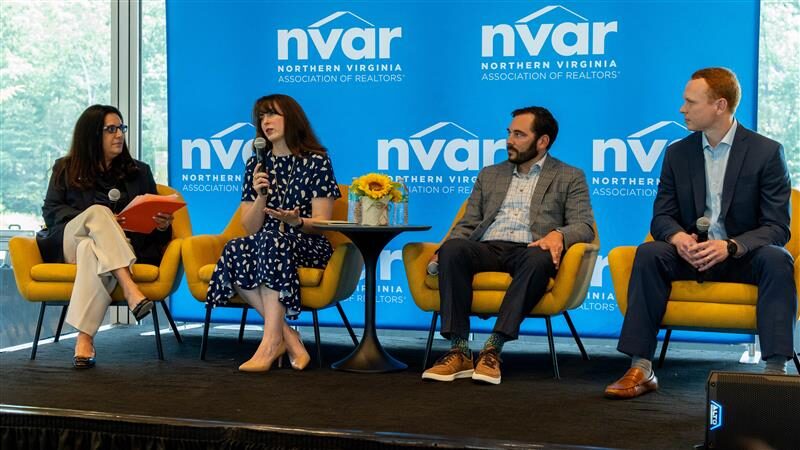
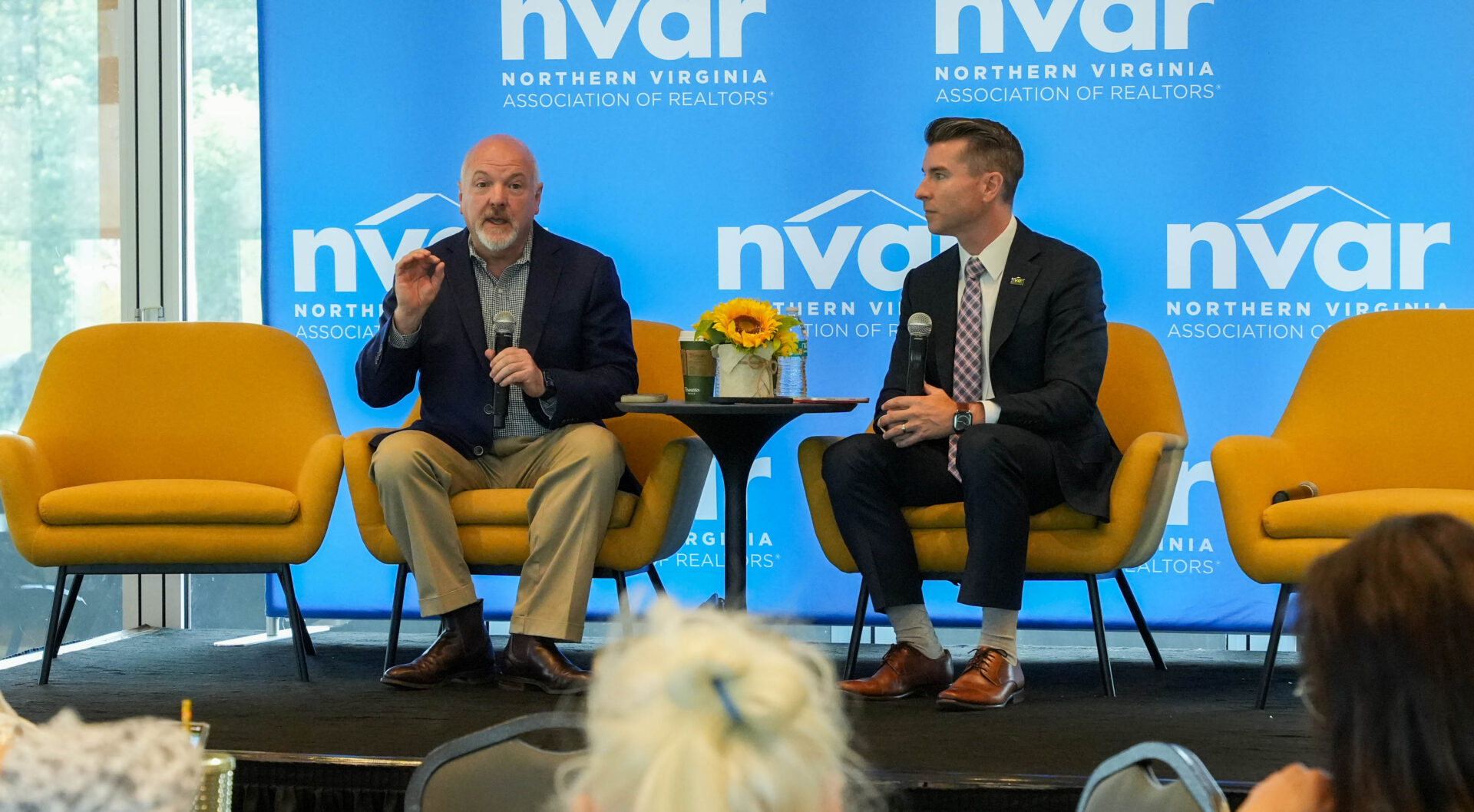
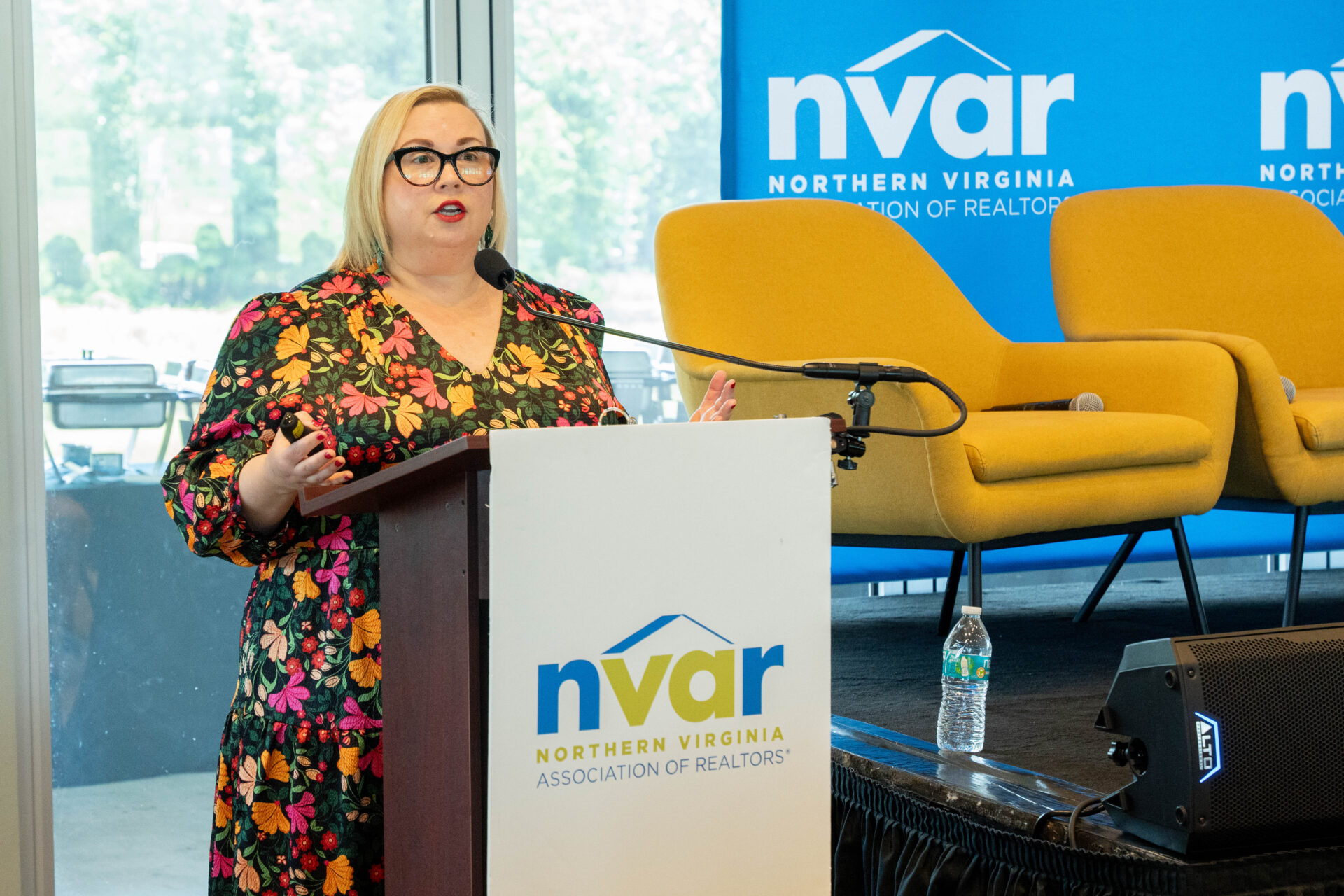
    The event featured keynote presentations from Dr. Terry Clower, Director of the Center for Regional Analysis at George Mason University, and Dr. Jessica Lautz, Deputy Chief Economist and Vice President of Research at the National Association of Realtors®. NVAR CEO Ryan McLaughlin sat down with Dr. Clower during his session on “Regional Analysis with NVAR and GMU,” where Dr. Clower provided a deep dive into the local economy, highlighting changes in employment, wage growth, and regional competitiveness. Dr. Lautz followed with a national perspective, focusing on demographic shifts reshaping the market — including the rise of multigenerational households, delayed homeownership, and sustained demand from first-time buyers. 

    2025 NVAR Economic Summit Recap - Image


    Two curated sessions offered attendees valuable perspectives on the challenges and opportunities ahead. In “The Economics of Development: What Drives Builder and Developer Decisions,” industry leaders Reid Allen (Pulte Group), Amy Friedlander (EYA), and Paul Jester (Van Metre Homes) shared a behind-the-scenes look at how builders and developers approach land acquisition, project selection, and market timing. The panel explored how factors like zoning regulations, land costs, entitlement processes, and population trends drive development decisions. Panelists emphasized that while buyer demand remains strong — particularly for walkable, mixed-use communities — access to land and predictable approval processes are essential to delivering new housing to market. 

    Later, “Regional Resilience: Opportunities for Growth in this Regional Economy” featured Alex Iams of the Fairfax County Economic Development Authority and Buddy Rizer of the Loudoun County Department of Economic Development. The session explored how local governments are positioning their communities for long-term economic growth by attracting industry, talent, and infrastructure investment. Both speakers highlighted the importance of public-private partnerships and major corporate investments in driving regional competitiveness and supporting housing demand. 

    Attendees left the summit with a deeper understanding of the macroeconomic and demographic dynamics shaping the future of real estate in Northern Virginia. From evolving buyer expectations to regional investment strategies, the day’s discussions reinforced the importance of data-driven decision-making and long-term strategic planning. For Realtors®, the summit served as both an educational opportunity and a call to action — underscoring their role in advancing sustainable, economically vibrant communities through informed advocacy and professional insight. 

    2025 NVAR Economic Summit Recap - Image


  • Market Statistics: May 2025

    Northern Virginia Housing Market Continues to Balance
    Sales Ease, Inventory Grows, and Prices Hold Steady Amid Changing Conditions
    FAIRFAX, Va. (June 10, 2025) The Northern Virginia housing market in May 2025 continued its
    transition toward more balanced conditions, with increased inventory and longer time on market giving buyers some needed breathing room, according to the Northern Virginia Association of Realtors® (NVAR). While the pace of sales has slowed slightly, home values remain strong — signaling that demand, though moderated, is still present in the region.


    A total of 1,764 homes were sold in May, marking a 4.2% decrease compared to May 2024. Total sold dollar volume reached approximately $1.56 billion, down 1.0% year-over-year. Despite the dip in sales activity, the median sold price rose 3.9% to $789,500, reflecting continued competition for well-priced homes.


    “We’re seeing a market that’s finding its footing,” said NVAR CEO Ryan McLaughlin. “Transaction
    volume has cooled modestly, which isn’t unexpected given broader economic headwinds and buyer sensitivity to interest rates. At the same time, price appreciation and rising inventory are signs that the market remains fundamentally sound — just adjusting to a new rhythm.”


    Homes spent an average of 15 days on the market in May — a 40% increase from this time last year. Meanwhile, active listings surged to 2,636 units, up 50% from May 2024. The months of supply rose accordingly to 1.96, a 48.4% increase year-over-year.


    “A growing number of listings means buyers now have more choices — and time to make them,” McLaughlin added. “But this isn’t necessarily a return to a buyer’s market. Sellers who price competitively are still seeing strong results, especially in Northern Virginia’s most desirable neighborhoods.”


    As the Northern Virginia real estate market continues to evolve, industry professionals are taking note of the shifting dynamics that are redefining the path to homeownership and sales. With rising interest rates, ongoing affordability concerns, and a cooling pace compared to the frenzied highs of previous years, both buyers and sellers are finding themselves in a more strategic playing field.


    NVAR Board Member Christina Rice, Pearson Smith Realty, observed that while the market is more measured, it’s also more complex. “This is a more nuanced environment, which can be both challenging and empowering,” said Rice. “Buyers may have more leverage, but affordability remains a concern for many. Sellers are still in a good position but may need to adjust expectations on timing and pricing. It’s not an easy market — it’s a smarter one. The key is working with experienced professionals who understand how to navigate it.”


    As buyers and sellers navigate this more nuanced and strategic market, NVAR continues to advocate for policy solutions that support long-term housing stability and attainability. NVAR leadership spent a full week in Washington, DC, attending the REALTORS® Legislative Meetings from May 31 to June 5, advocating for policies aimed at improving housing attainability and expanding access to homeownership. Key priorities included increasing housing supply, raising the cap on the State and Local Tax (SALT) deduction, and doubling the capital gains exclusion on the sale of a principal residence. While in DC, NVAR members met directly with policymakers, including Virginia Senator Mark Warner, to advance these critical issues. “Our time in Washington was focused on championing solutions that help more Virginians achieve the dream of homeownership,” said Josh Veverka, NVAR Vice President of Government Affairs. “By pushing for smart, forward-looking policies, we’re working to address the supply shortage and affordability barriers that impact our region every day.”


    Looking ahead, with underlying demand remaining strong and supply gradually improving, Northern Virginia is positioned to move forward with a sense of steady momentum and cautious optimism — even as national and global economic factors continue to influence local trends.

    Market Statistics: May 2025 - Image

    Market Statistics: May 2025 - Image

    Press ReleaseMarket Statistics: May 2025 - Image

  • National Market Statistics Comparison: April 2025

    Northern Virginia Outpaces U.S. Housing Market in April with Stronger Prices and Inventory Growth

    Region Shows Greater Stability Than National Trends

    FAIRFAX, Va. (May 27, 2025)  The national housing market saw a continued slowdown in April, but Northern Virginia stood out with stronger home price appreciation, increased inventory, and steady buyer activity that signaled resilience and stability across the region, according to the Northern Virginia Association of Realtors® (NVAR).

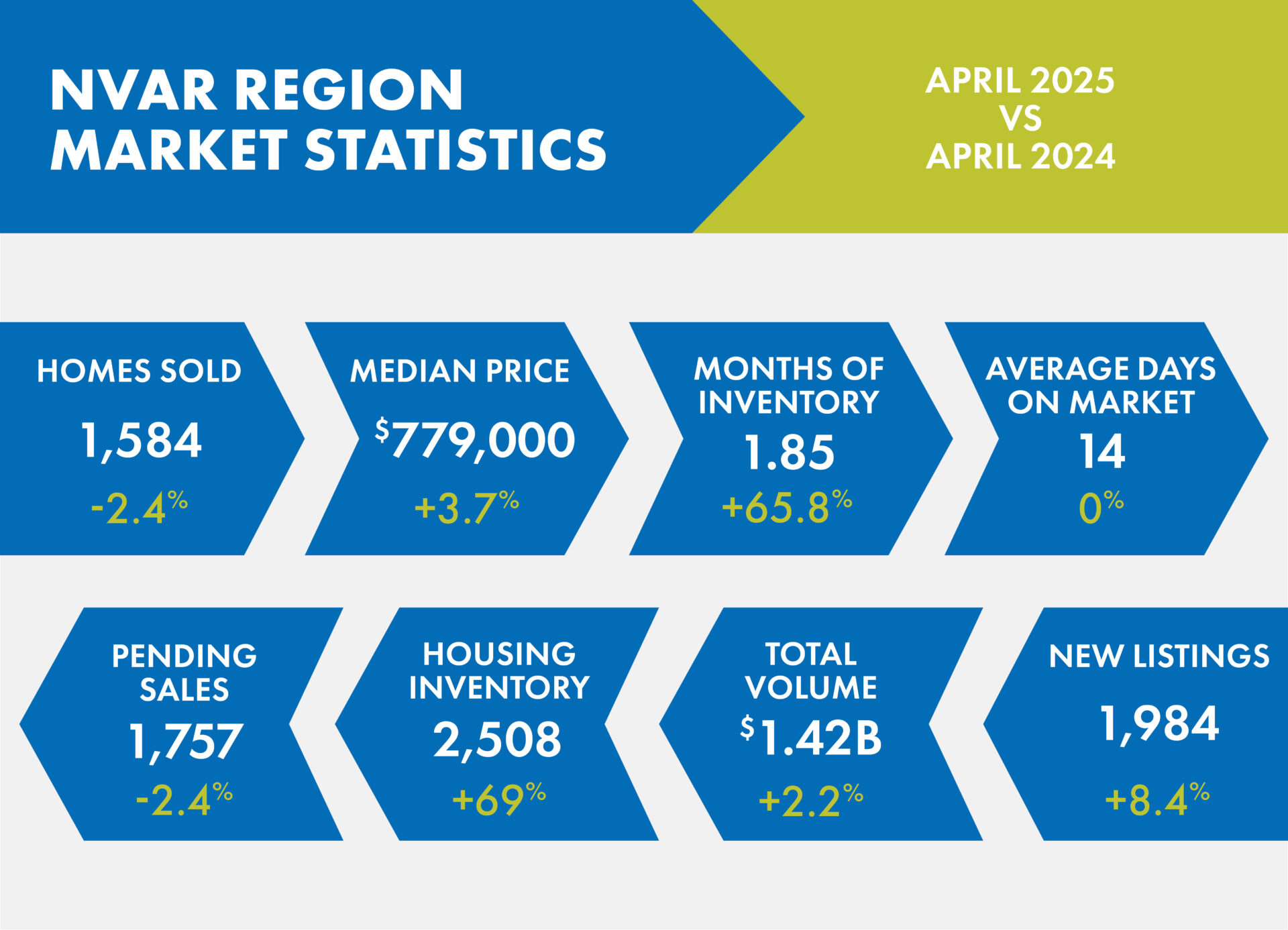
    Northern Virginia’s housing market continued to demonstrate strong price growth in April, with the median sold price rising 3.7% year-over-year to $779,000 — significantly outpacing the national increase of 1.8%, which brought the U.S. median to $414,000. While closed sales in the region dipped 2.4% compared to April 2024, the decline was in line with national trends, where existing-home sales totaled 4.0 million — a 2.0% decrease from the previous year.

    “Our region continues to distinguish itself as a high-demand, high-value market, even amid broader national headwinds,” said NVAR CEO Ryan McLaughlin. “While many U.S. markets are experiencing a slowdown, our region is maintaining upward price momentum and seeing a significant boost in inventory — both signs of a healthier, more balanced housing landscape.”

    Inventory in Northern Virginia rose significantly in April. Active listings reached 2,508 homes — a 69% year-over-year increase — and months of supply jumped to 1.85, up 65.8% from April 2024. In comparison, the national months of supply rose more modestly to 4.4 from 3.5 year-over-year. Nationally, the average days on market was 29 days, an increase from 26 days in April 2024. Meanwhile, Northern Virginia’s average days on market was considerably lower at 14 days, unchanged from a year ago and underscoring continued buyer interest.

    “This kind of supply growth gives both buyers and sellers greater confidence,” McLaughlin added. “Buyers are no longer pressured by extreme scarcity, and sellers are still benefiting from strong home values. The Northern Virginia market is approaching a healthier balance that supports long-term sustainability. Homes are still moving quickly, with average days on market holding steady at just 14 days — a sign that demand remains steady.”

    While some national markets are seeing a softening in competition, Northern Virginia’s pricing power and buyer engagement remain intact. This positions the region as a continued bright spot in an otherwise cooling national landscape.

    “The Northern Virginia housing market remains steady, with varying levels of activity depending on the area,” said NVAR President Casey Menish, Pearson Smith Realty. “Local dynamics play a key role, and we continue to monitor potential impacts from changes to the federal workforce. Overall, confidence in the market continues to hold.”

    With both national and local markets in a period of transition, Northern Virginia’s April performance suggests a path of relative strength and opportunity as the spring market continues to unfold.

    NVAR’s 2025 Housing Forecast, produced in conjunction with the George Mason University Center for Regional Analysis, indicates that the Northern Virginia housing market will keep strengthening with moderate price increases and higher levels of market activity. Northern Virginia’s outlook is similar to the national 2025 housing forecast that predicts the worst of the housing inventory shortage is ending, mortgage rates are stabilizing, and job additions are continuing.


    BACKGROUND

    The Northern Virginia Association of Realtors® reports on home sales activity for Fairfax and Arlington counties, the cities of Alexandria, Fairfax, and Falls Church and the towns of Vienna, Herndon, and Clifton. Below is April 2025 regional home sales compared to April 2024 for Northern Virginia, with data derived from Bright MLS as of May 9, 2025 (total sales and listings may not include garage/parking spaces):

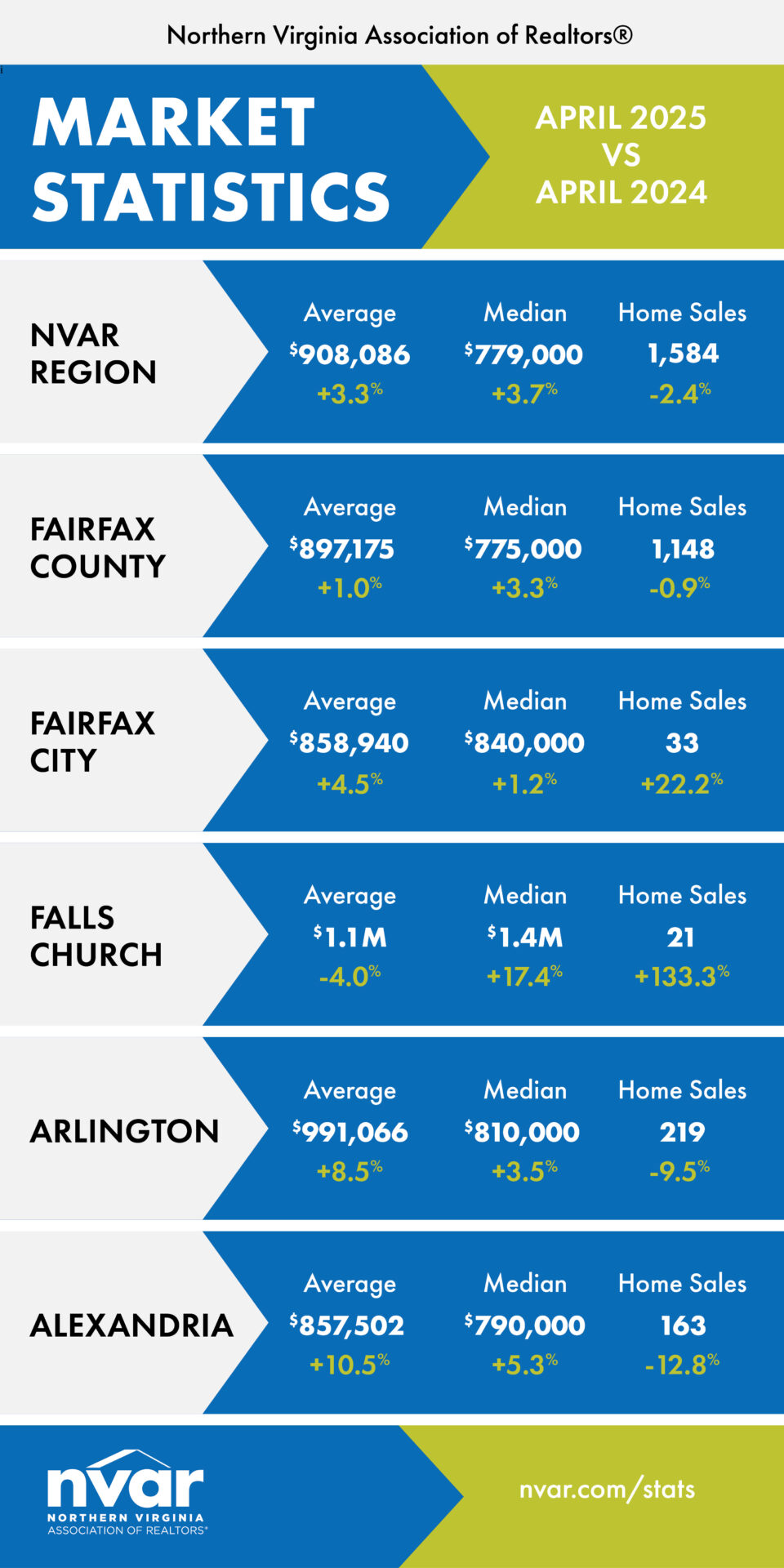
    • The number of closed sales in April 2025 was 1,584 units. This was a 2.4% decrease compared to April 2024.  
    • The volume sold in April 2025 was $1,419,601,631. This was a 2.2% increase compared to April 2024.
    • The average sold price was $908,086 in April 2025. This was up 3.3% compared to April 2024.
    • The number of new pending sales in April 2025 was 1,742 units. This was down 5.5% compared to April 2024.  
    • The number of active listings in April 2025 was 2,508 units. This number was up 69.0% compared to April 2024.
    • The number of new listings in April 2025 was 1,984 units. This number was up 8.42% compared to April 2024.

    Read more about the NVAR regional housing market at nvar.com/Marketstats.

    NVAR Charts, Graphs, Social Media for April 2025 NVAR Housing Stats  

    April Housing Data: Click here.

    Regional Jurisdiction Infographic: Click here.

    NVAR Region Infographic: Click here.

    NVAR 2023 Housing Economic Impact Report: Click here.

    NVAR 2025 Housing Forecast Update Report: Click here.

    These links are accessible from the Market Stats page here: Click here.


    About NVAR

    The Northern Virginia Association of Realtors® (NVAR) serves as the voice of real estate in the Greater Northern Virginia Region. NVAR is dedicated to enhancing Realtor® success by delivering exceptional value, driving innovation, and impacting the industry. Headquartered in Fairfax, Virginia, NVAR supports its 12,000 members with essential resources, including industry education, advocacy, networking, and professional development opportunities. The Association is committed to promoting ethical practices and excellence in real estate. It advocates on behalf of homebuyers, sellers, renters, and commercial tenants who are directly affected by local, state, and federal policy decisions impacting affordability, property rights, and quality of life. NVAR strives to elevate the standards of the real estate industry and to contribute to the overall growth and prosperity of the Washington DC Metropolitan Area and beyond. nvar.com. 

    Follow us on X: @nvar

    Visit us on Facebook: facebook.com/nvar.realestate 

    Join us on LinkedIn: NVAR

    Follow us on Instagram: nvarffx

  • Market Statistics: April 2025

    Northern Virginia Housing Market Balances in April Amid Shifting Supply and Resilient
    Prices
    FAIRFAX, Va. (May 13, 2025) The Northern Virginia Association of Realtors® (NVAR) reports that
    the regional housing market in April 2025 demonstrated a notable shift toward equilibrium, marked by a dramatic increase in active listings and steady home prices, even as closed sales saw a modest year-over-year decline.


    A total of 1,584 homes were sold in April, representing a 2.4% decrease from April 2024. Yet,
    despite fewer transactions, the total dollar volume climbed to more than $1.4 billion, a 2.2%
    increase from the previous year — driven in part by the continued rise in home values. The median sold price jumped 3.7% to $779,000, underscoring sustained buyer demand in a competitive region.
    “Rising prices and steady buyer interest signal that Northern Virginia’s housing market remains
    fundamentally strong, even as overall sales dipped slightly,” said NVAR CEO Ryan McLaughlin.
    “Homeowners continue to benefit from meaningful equity growth, while buyers are acting decisively when the right opportunity arises.”


    At the same time, market dynamics are evolving. The number of active listings grew 69.0%,
    reaching 2,508 properties, and months of supply rose to 1.85, a 65.8% increase compared to April 2024. This infusion of inventory signals a step toward a more balanced market. Meanwhile, the average days on market held steady at just 14 days, highlighting continued demand.


    “Today’s market presents exciting opportunities for home buyers, who now benefit from more
    choices and a better chance of having their offers accepted,” said NVAR Board Member Rob
    Carney, TTR Sotheby’s International Realty. “For home sellers, it’s a great time to stand out by
    pricing strategically and presenting their homes in the best possible light.”


    The shift benefits not only buyers but also sellers who can now navigate the market with a clearer sense of expectations and timing. And, while inventory has increased significantly, there is still no significant data to indicate that this is being driven by changes in the federal workforce, as some have speculated in recent months.


    “With a healthier balance between supply and demand, we’re seeing a more stable marketplace
    emerge,” McLaughlin added. “That’s good for long-term sustainability and economic vitality in our region.”


    While the market continues to evolve, Northern Virginia remains one of the most sought-after
    regions in the country, supported by a resilient local economy, diverse communities, public
    transportation access, and proximity to the nation’s capital. These factors continue to attract buyers and provide a strong foundation for continued growth and housing demand.


    NVAR’s 2025 Housing Forecast, produced in conjunction with the George Mason University Center for Regional Analysis, indicates that the Northern Virginia housing market will keep strengthening with moderate price increases and higher levels of market activity. Northern Virginia’s outlook is similar to the national 2025 housing forecast that predicts the worst of the housing inventory shortage is ending, mortgage rates are stabilizing, and job additions are continuing.

    Market Statistics: April 2025 - Image

    Market Statistics: April 2025 - Image

    Press ReleaseMarket Statistics: April 2025 - Image

    Home Sales ReportMarket Statistics: April 2025 - Image

×

Member Login

Lookup NRDSID Forgot Password?