
July 2024
The Northern Virginia Association of Realtors® (NVAR), in conjunction with the Center for Regional Analysis at George Mason University (GMU-CRA), issues a consensus forecast for the NVAR region’s housing market. The association convenes a panel of key experts from differing sectors of the real estate industry to review preliminary forecasts developed by GMU-CRA economists and offer their insights into current and near-future market conditions. The following represents the forecast team’s mid-year update to the 2024 outlook.
While both the residential and commercial continue to stabilize, the region’s real estate market still has not reached a post-pandemic equilibrium. The inflation rate has continued to slow, with core inflation declining steadily since September 2022. Additionally, the national labor market has remained stronger than anticipated. While hopes of a soft-landing remain, there are continued signs of weakness:
- While the unemployment rate remains low, it has been increasing since early 2023.
- Temporary help employment, which declines during recessions, has been declining since March 2022.
- Overall inflation has moderated to 3.0% in the June 2024 reading; however, household budgets are stretched due to cumulative price increases.
- Households have spent down their excess savings accumulated during the pandemic.
While the prospects of a soft landing remain, the rise in interest rates that began over 2 full years ago appears to only now be impacting national economic performance. While a national recession remains a possibility, actions taken by the Federal Reserve in the near term will greatly impact the trajectory of the national economy. Our forecast for the DC region is that job growth will stagnate this summer after three years of moderation. While we may see job losses in the second half of the year, losses are not anticipated to be large or last long enough to qualify as a regional recession.
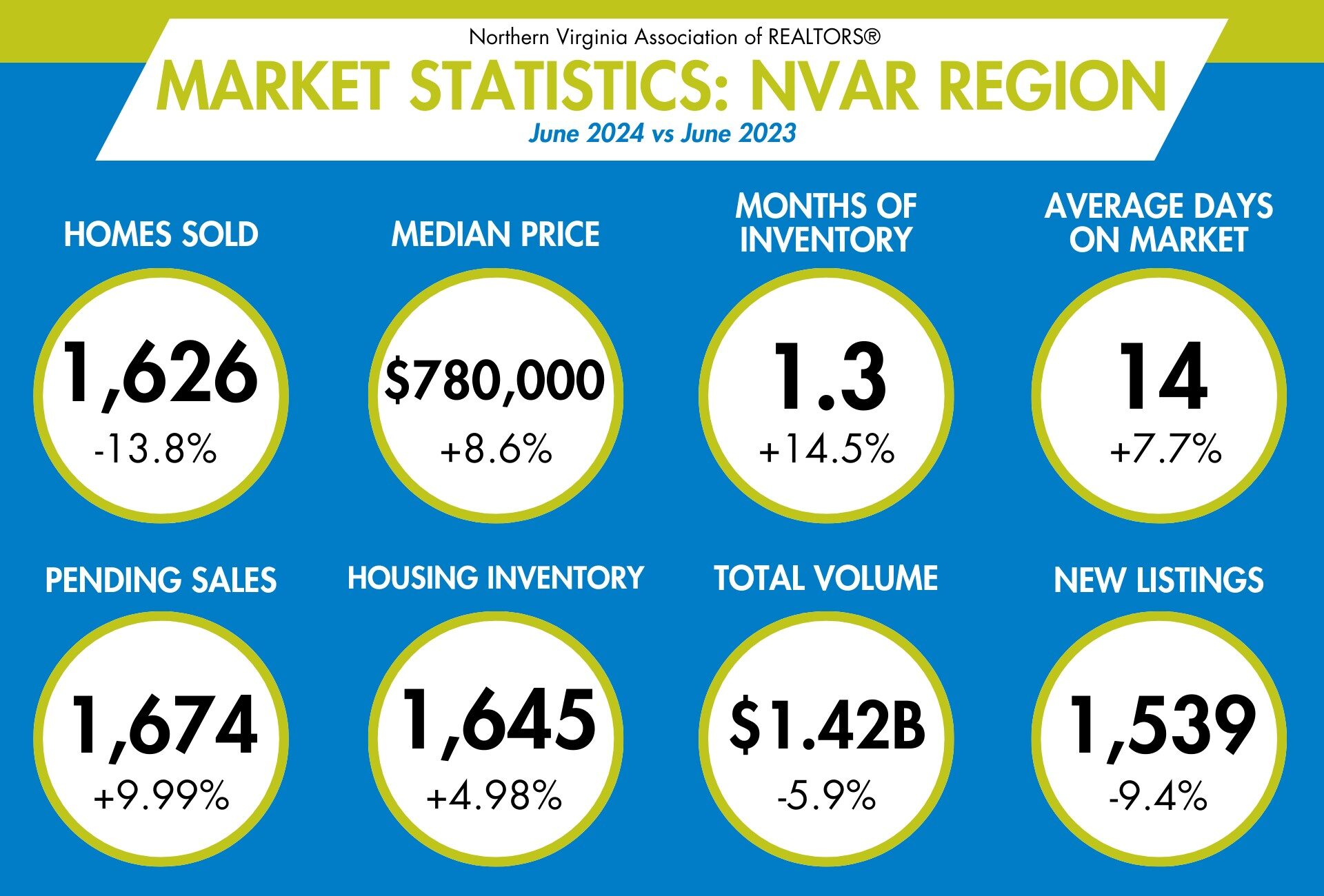
As has been the case for several years now, home values continue to appreciate in the face of higher mortgage rates due primarily to low inventory. The inventory of for-sale homes has continued to surprise to the downside, made only worse by homeowners holding onto their 3% mortgage rates. Uncertainty around the Federal election will further weaken the economic prospects of the region as businesses are likely to hold off on any major decisions until after November 5th, 2024.
While the region’s economic outlook continues to be plagued by weakness and uncertainty, there are hopeful signs:
- Housing demand continues to outpace supply, driving price stability.
- Local jurisdictions are starting to take real action to increase the supply of for-sale homes at prices affordable to young professional families, a requirement for economic success, even if the supply hasn’t started to matriculate just yet.
- Hybrid work has been fully embedded into work-life, resulting in a geographic expansion of the Northern Virginia labor/housing market.
- Northern Virginia continues to attract regional workers.
- The region’s spring housing market activity surprised to the upside.
As Northern Virginia has continued to expand in the wake of the pandemic, it’s regional importance has only increased. What were once outer suburbs of DC have become more central neighborhoods for job centers in Arlington and Fairfax. This, along with hybrid work, has allowed workers to locate even farther from core jurisdictions (inside the beltway). As a result, more Northern Virginia Realtors® are expanding their business and transacting real estate in Loudoun, Prince William, and Stafford counties. We have followed suit and expanded the regional housing market forecast to include these jurisdictions.
Forecast by Jurisdiction
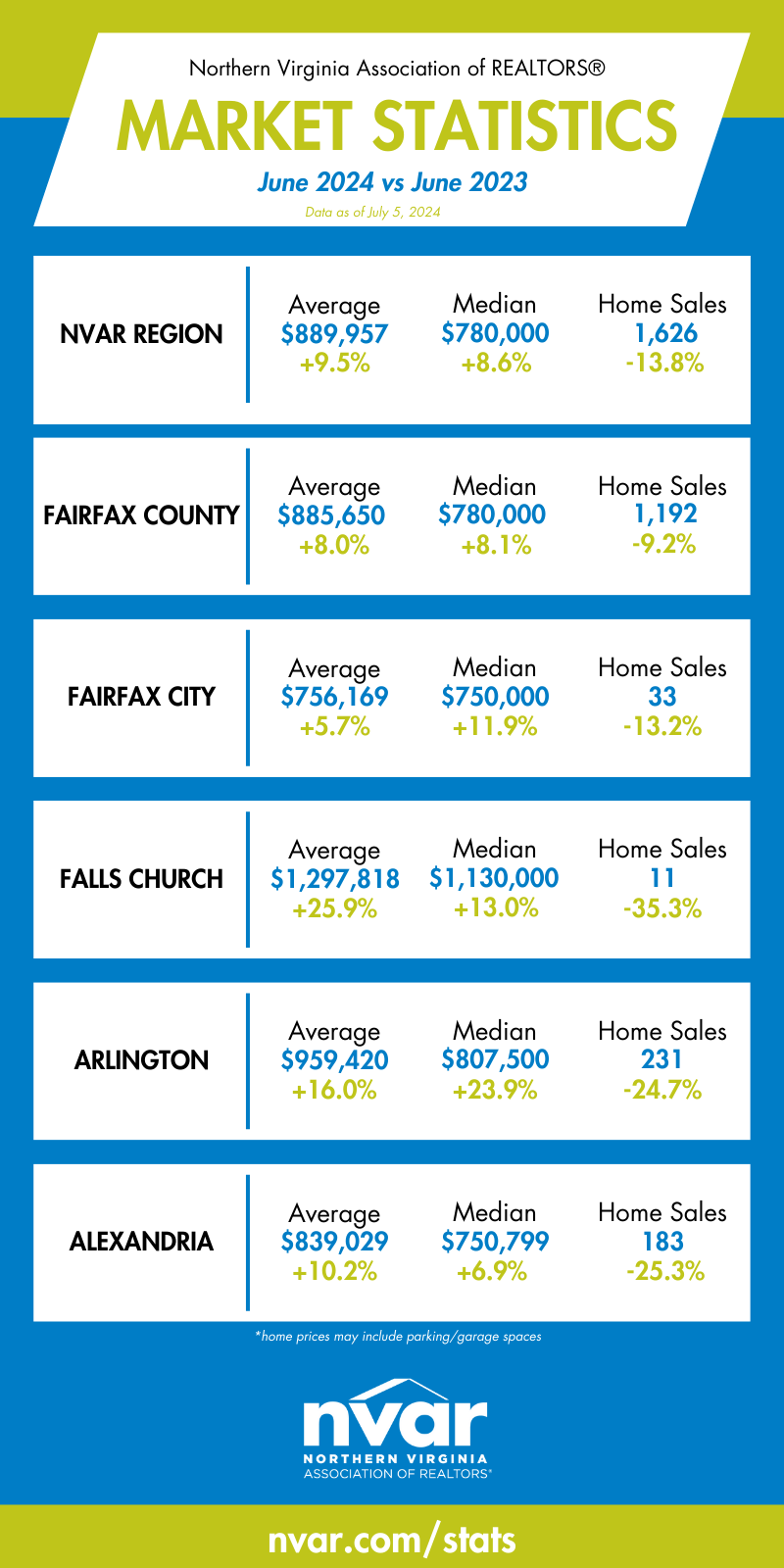
Fairfax County (view charts)
The market for single family homes in the region’s largest jurisdiction has returned to growth with prices forecast to by up 8.1% from December 2023 to December of 2024. Inventory has rebounded marginally, with average month-end inventory forecast to increase 1.6% from 2023 to 2024, leading to an increase in total sales volume of 4.6% from 2023 to 2024.
Relatively flat inventory for townhomes will weigh on total townhome sales in Fairfax County, as existing owners are likely to choose their 3% mortgages over more space. However, given that demand remains relatively strong, prices for townhomes are forecast to increase 3.9% from December 2023 to December 2024.
Prices for Fairfax condominiums are forecast to grow more modestly than single family or townhomes, gaining 2.9% from December 2023 to December 2024. This trend is partially the result of relatively large increases in average month-end inventory, which is forecast to increase 10.0% from 2023 to 2024. Increased inventory will lift total sales volume 1.7% from 2023 to 2024, a welcome change after two years of slowing sales volume.
Arlington County (view charts)
Overall affordability and mortgage rates continue to constrain price gains of single-family homes in Arlington after robust increases the past several years. Median prices for Arlington single family homes will increase 0.7% from December 2023 to December 2024. After two years of contracting inventory, average month-end inventory is forecast to increase 2.1% from 2023 to 2024, which will lift total sales volume 5.5% over the same period.
Strong demand for Arlington will push prices for Arlington townhomes up 13.3% from December 2023 to December 2024. Furthermore, a 2.9% increase in average month-end inventory from 2023 to 2024 will help lift sales volume 9.4% over the same period.
While average month-end inventory for condos will be down 1.6% in 2024, demand will continue to support sales volume and price growth. Total sales volume will increase 5.1% from 2023 to 2024, while the median sales price of condos is forecast to increase 4.2% from December 2023 to December 2024.
Alexandria City (view charts)
Alexandria is the smallest market in Northern Virginia. There are relatively few sales of single-family units each month, resulting in sizable price swings depending on the characteristics of monthly sales (size, location, etc.). While the price of single-family homes is forecast to decline 5.6% from December 2023 to December 2024, the more notable trend is continued moderation of monthly price swings. Average month-end inventory will increase just 2.7% from 2023 to 2024, and total sales will follow suit, increasing 2.5% over the same period.
Alexandria townhome inventories are forecast to be down 7.6% in 2024 with sales activity remaining relatively flat, growing just 2.1% on average for the year. Prices will decline moderately, falling 0.9% from December 2023 to December 2024.
Demand for Alexandria condos has cooled, with average month-end inventory now forecast to increase 1.3% from 2023 to 2024, as sales are forecast to decline 4.6%. Despite the building inventory, the median price of sold condos in Alexandria will grow a modest 4.5% from December 2023 to December 2024.
Prince William County (view charts)
Prince William County continues to be an attractive option for families seeking comparatively affordable single family homes that simply are not available in Arlington, Alexandria, and increasingly in Fairfax. Unfortunately, average month-end inventory is forecast to decline 10.2% from 2023 to 2024. Inventory constraints will weigh on total sales, which are forecast to increase just 2.4% from 2023 to 2024. While supply continues to be constrained, demand remains, and prices are forecast to increase 8.9% from December 2023 to December 2024
The median sales price of townhomes in Prince William County is forecast to increase 7.5% from December 2023 to December 204, further reflecting the multi-year trend of families seeking this more affordable, but family-sized housing options. While sales volume growth of townhomes is anticipated to be in-line with single family, increasing 2.2% from 2023 to 2024, average month-end townhome inventory is forecast to increase 3.4%, indicating that days on market may start to increase modestly.
Although the condominium market in Prince William County is small, it is forecast to be strong for the remainder of 2024. The median sales price of condos in Prince William is forecast to increase 32.0% from December 2023 to December 2024. Furthermore, total sales are forecast to increase 3.1% from 2023 to 2024 while the average month-end inventory is expected to decrease 18.2%.
Loudoun County (view charts)
After a year of slow price appreciation in 2022, prices for single family homes in Loudoun County returned to strong price appreciation, which is forecast to continue with the median price of sold single family homes in Loudoun County increasing 5.4% from December 2023 to December 2024. The strong demand will result in average month-end inventory forecast decline 5.0% from 2023 to 2024 while the number of sales will increase 6.2%.
Similarly, townhome prices are forecast to increase 7.0% from December 2023 to December 2024, and total sales are forecast to increase 2.2% from 2023 to 2024. However, inventory is anticipated to build, with the average month-end inventory growing 9.6% from 2023 to 2024.
Average month-end inventory of condominiums for sale in Loudoun County is a bright spot for buyers, as it is forecast to increase 19.6% from 2023 to 2024. The building inventory will prop up sales volume, forecast to increase 5.8% from 2023 to 2024, and keep price appreciation low, with the median sales price of sold units to increase just 0.3% from December 2023 to December 2024.
Stafford County (view charts)
Prior to the onset of the pandemic, Stafford County began to record a huge contraction in month-end inventory of single-family homes. The constrained inventory has remained low in the wake of the pandemic and is set to decline only marginally, with the average month-end inventory forecast to decline just 3.4% from 2023 to 2024. Low inventory will be a headwind for sales, which are forecast to decline 2.4% from 2023 to 2024. Given that demand remains, prices are set to increase 2.4% from December 2023 to December 2024.
The average month-end inventory of townhomes, while representing a small market, is forecast to decline 22.8% from 2023 to 2024, as buyers continue to look for affordable, family-sized, housing. As with single family homes in Stafford, the tightening market will impact total sales, which are forecast to decline 0.3% from 2023 to 2024. While there may be less to buy and fewer sales, demand remains and those looking to buyer are forecast to push up the median price of sold townhomes 3.8% from December 2023 to December 2024.
Although the condo market in Stafford is among the smallest markets in the Greater Northern Virginia region, average month-end inventory is set to increase 45.1% from 2023 to 2024. This is forecast to result in a 26.4% increase in total condo sales in the county all while the median price of sold condos increases 13.1% from December 2023 to December 2024
Learn more at cra.gmu.edu and NVAR.com/stats.