by Ryan McLaughlin, CEO of NVAR
People vs. Policy
The answer is simple: the impact of elections on our housing market is negligible when it comes to incoming and outgoing people. However, the most recent election might present a different answer when it comes to policies the new administration has in mind.
People
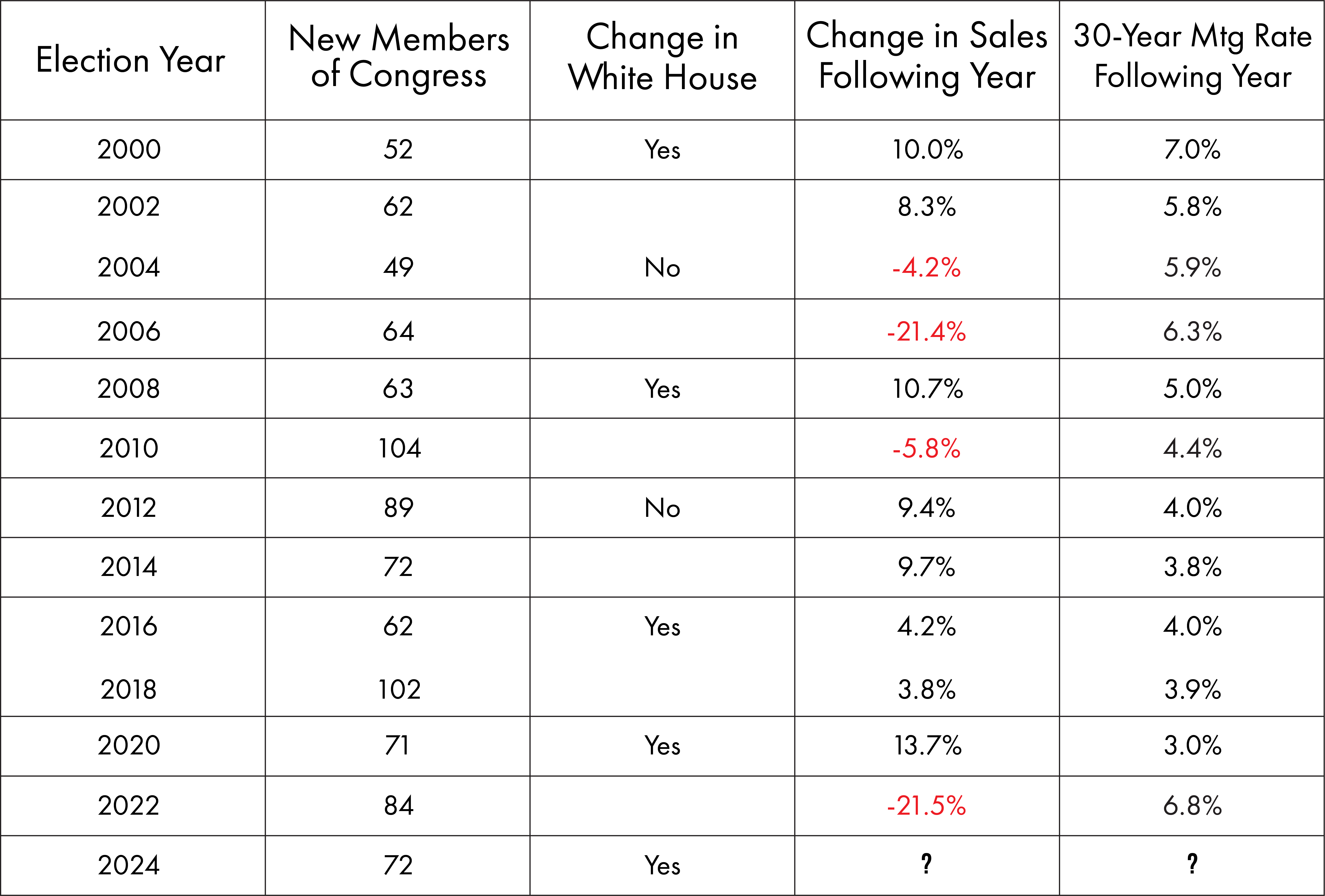
An analysis of Congressional and Presidential election cycles since 2000 shows no correlation between changes in Congress or the White House and real estate activity in the Washington DC Metropolitan Area. Despite the influx of 72 newly elected members of Congress and a new occupant in the White House, this is typical. The average number of new Congressional members since 2000 is also 72, and there have been five changes in White House occupancy over the last seven elections.
After the 2010 election, where significant changes occurred, home sales dropped by 5.8% in 2011. Conversely, sales increased by 3.8% after 102 seats changed hands in 2018. Here is why elections do not significantly move the needle:
- Executive Branch Jobs: There are approximately 8,000 politically appointed jobs in the Executive Branch. With changes brought about by the new administration and assuming that half the appointees relocate to the region, this would generate around 2,000 additional home sales over 12-18 months — a generous overestimate.
- Congressional Staff: With 15,000 politically appointed jobs in Congress, even after major turnover (e.g., 2010), only a fraction of these staffers buy homes. Many staffers already reside in the region or rent due to salary constraints. This results in fewer than 1,000 home purchases following a significant election.
- Turnover Timing: Politically related job changes occur gradually. New administrations often take a year or more to fill all politically appointed positions, further diminishing the immediate impact of elections.
- Market Scale: Even during high turnover elections, fewer than 3,000 additional home purchases occur annually. With an average of over 70,000 home sales each year in the region, this is not enough to significantly impact the market.
The DC region’s real estate market is far more influenced by overall economic conditions than by election-related population changes.
Mortgage Rates
Mortgage rates are tied broadly to Federal Reserve Bank (FRB) interest rates. Homebuyers have anticipated the FRB’s plans to lower rates throughout 2025. However, recent inflation trends are causing concern that rate cuts may be paused. In addition, proposed tariffs on imports may increase goods prices and likely shift the Fed back to raising interest rates. This would cause mortgage rates to increase and push some families out of the home buying market.
Policy
The potential impact of policies from the new administration is a different matter. The following have already been initiated:
- Return-to-Office Mandates: Federal employees’ return to physical offices could bolster downtown DC’s businesses. However, with over 30% of local federal employees eligible for retirement, some may opt out of the workforce entirely rather than face long commutes. This raises questions about whether they will sell homes, stay in the area, or transition to civilian employment.
- Job Reductions: Federal job cuts could significantly affect the housing market and broader economy. Federal employment has been the region’s economic cornerstone, and widespread job losses could reduce housing demand.
- Department Eliminations: While discussions about eliminating federal departments are ongoing, such changes are unlikely to occur overnight. Constituencies dependent on federal programs often push back against proposed cuts, prolonging implementation.
The Northern Virginia Association of Realtors® (NVAR) has observed that while elections rarely have a direct impact on the number of homes bought or sold in the Washington DC Metropolitan Area, their influence on housing market dynamics can be more significant when considering federal policies introduced by the new administration. The DC region’s housing market is inherently tied to the stability of federal employment and related industries. Current policies such as return-to-office mandates and reductions in federal jobs could alter housing demand patterns, particularly if they lead to shifts in the workforce or retirement decisions among federal employees. Additionally, federal spending decisions often ripple through the local economy, influencing market confidence and economic activity. However, the region’s economic resilience, coupled with the high desirability of living here, ensures a strong foundation even amidst policy-driven uncertainties. According to NVAR’s recent 2025 Housing Forecast, produced in conjunction with the George Mason University Center for Regional Analysis, the region’s housing market will keep strengthening with moderate price increases and higher levels of market activity.
We are fortunate to have a very resilient regional economy, and we will all be following these developing issues closely.
This article was developed with David Howell, 1995 NVAR Past President and Terry L. Clower, Ph.D., Director, Center for Regional Analysis, George Mason University