NOVA Housing Supply Framework
One thing is clear: Reform is essential.
The NOVA Housing Supply Framework is a bold, regionally unified, locally adaptable strategy to increase housing supply, protect affordability, and preserve economic competitiveness — driven by those who build homes, sell homes, and power the regional economy. The Framework was authored by the Northern Virginia Association of Realtors® (NVAR), in partnership with the Northern Virginia Chamber (NVC), and the Northern Virginia Building Industry Association (NVBIA). It sets forth policy strategies to increase housing supply, improve affordability, and restore regional competitiveness.



Housing Framework Regional Coalition Members


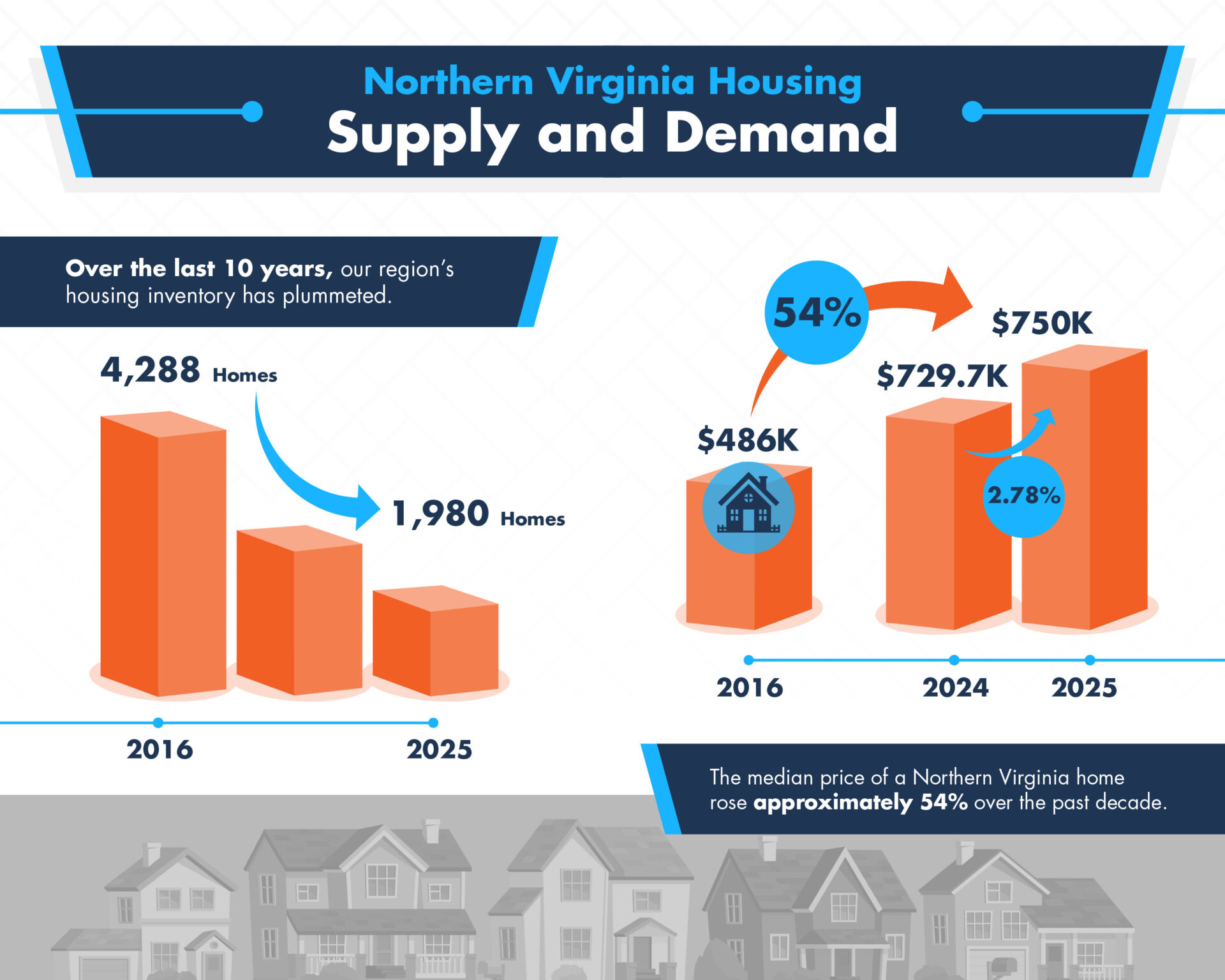
The median price of a Northern Virginia home in 2025 rose to $750,000, up 2.78% from $729,710 in 2024 and approximately 54% over the past decade from a median home price in 2016 near $486,000.
First-time homebuyers may be locked out of a housing market that is increasingly dominated by repeat buyers and older generations. Rising home prices, low inventory, out-of-reach new-home construction, and prolonged development timelines have pushed homeownership further away for many households who form the backbone of the region’s workforce. The impacts are increasingly visible: delayed household formation, longer commutes, reduced economic mobility, and a steadily rising age of first-time homebuyers — which is now 40 years old.
Limited Buying Power for Essential Workers in the Region: What the average employee can afford to buy in Northern Virginia
Law Enforcement Officer
An average law enforcement officer in Northern Virginia earns $135,758 annually, giving them a purchasing power of $475,153. Despite this high income, they can only afford about 25% of the homes on the market today.
Healthcare Workers
Healthcare workers, with an estimated income of around $109,288, can access roughly 7% of the homes in Northern Virginia.
Teachers
Teachers earn an average of $70,213, can only access about 3% of the homes across the region.
Zoning and land-use restrictions, coupled with time-consuming and unpredictable approval processes, are among the most significant drivers of housing cost and supply constraints in Northern Virginia. These barriers inflate development costs, suppress production, and ultimately shift the burden to consumers. While many of these zoning policies helped shape Northern Virginia into a highly sought-after place to live, the need for policy reforms that prioritize supply, predictability, and market responsiveness are clear — we need to adapt now to grow and thrive.
Over the last 10 years, our region’s housing inventory has plummeted from 4,288 homes on the market in March 2016 to 1,980 active listing on the Market in March 2025.
If Northern Virginia local governments do not act swiftly, the consequences may be severe:
- Homeownership will continue to be out of reach for the workforce — eroding long-term wealth creation, intergenerational stability, and community continuity.
- Employers will struggle to attract and retain talent.
- Northern Virginia will struggle to attract and retain employers.
- Political pressure will intensify, leading to state-level intervention and policymaking that reduces local control.
We have already seen state-level intervention as a major theme in the 2026 General Assembly session. Many of the strategies outlined below were included in statewide proposals to override local control of planning and zoning—summaries of these statewide alternatives are included.
In the weeks ahead, the NOVA Housing Supply Framework will take this beyond a one-size-fits-all approach and present tailored policy recommendations for each jurisdiction across the region, offering practical steps for local governments building on the priorities and strategies outlined below. NVAR welcomes the opportunity to continue this dialogue and work together in the months ahead to ensure Northern Virginia remains a vibrant and accessible place to live.
Objective #1: Expand the Range of Housing Types That Can Be Built
Across Northern Virginia, zoning codes frequently limit housing production by restricting density, mandating large lot sizes, and prohibiting common ownership-oriented housing types. These restrictions are limiting the types of housing that can be built today and are frequently cited as the reason builders no longer construct “starter” homes and attainable housing options.
Create small-lot zones with properties between 1,500 and 5,000 square feet in all areas, where wastewater infrastructure will allow for increased housing, with by-right subdividing of properties within these zones. Additionally, seek to reduce all residential lot size minimums across the jurisdiction unless necessary for the protection of public health and safety.

Statewide Preemption Alternative: HB212: Small lot residential zoning districts. Requires any locality with a population of 20,000 or more to create zoning districts that permits by-right one and two-family dwellings and townhouses on 3,000 square foot lots.
Expand housing options by allowing low-density multifamily housing and single-family attached housing in certain areas currently zoned for single-family detached housing only. Efforts may focus on housing types that are most likely to be ownership housing stock, such as townhomes, duplexes and triplexes, and be located in areas suitable for accommodating the type of housing and use intensity such as those in proximity to transit and transportation hubs, town centers, and commercial zones.
Statewide Preemption Alternative: HB804: Statewide housing targets for localities. Requires localities to increase their total housing stock by at least 7.5 percent over the five-year period beginning in 2028. Requires localities to adopt (i) a zoning ordinance that includes provisions allowing for the by right development and construction of multifamily residential uses on at least 75 percent of all land contained in commercial or business zoning district or (ii) at least three of the housing growth strategies enumerated in the bill, including missing-middle type provisions.
Amend Accessory Living/Accessory Dwelling Unit (ALUs/ADUs) Ordinances to encourage development and streamline processes for owners and builders, to include: eliminating minimum lot sizes for ALUs/ADUs (while maintaining appropriate setbacks); eliminate owner occupancy requirements, reduce parking requirements in proximity to transit, allow family-sized units and occupancy (while maintaining subordinance to main home), allow manufactured or modular home types, explore condominium style sales opportunities for ALUs/ADUs.
Statewide Preemption Alternative: HB611: Zoning; development and use of accessory dwelling units. Requires a locality to include in its zoning ordinances for single-family residential zoning districts accessory dwelling units, or ADUs, as defined in the bill, as a by-right permitted accessory use. Limits the zoning restrictions the locality may impose on the accessory dwellings.
Encourage the development of diverse senior housing options to support “right-sizing” and unlock existing housing supply. Local governments should proactively support the development of age-friendly housing, including active adult communities, accessible housing, and smaller downsizing options, particularly in walkable mixed-use and transit-oriented areas.
The fastest way to increase family housing supply may not always be building new homes, it could be making it easier for existing homeowners to right-size into housing that better fits their needs. When attractive downsizing options are available, these residents are more likely to transition into housing better suited to their needs, allowing existing single-family homes to return to the market for younger families.
Objective #2: Improve Speed to Market and Developer Costs Through Regulatory and Permitting Reform

Even where zoning allows housing to be built, the time, cost, and uncertainty associated with approvals can be prohibitive. Delays related to rezonings, hearings, local staff review, state agency review, and discretionary processes can account for a significant share of total development costs. National best practices emphasize predictability, clarity, and administrative efficiency as essential components of housing supply reform.
Establish a reasonable and achievable expedited timeline for residential rezoning, site planning, permitting, inspections, and review, and codify the specific timeframe for completion in the zoning ordinance. While this timeline may differ for each jurisdiction, all effort should be made to eliminate redundancy, implement concurrent review processes, and provide adequate staffing to achieve approval times aligned with jurisdictions of similar size and economic competitiveness. Residential decisions would default to “approved” if the jurisdiction fails to meet statutory timeline requirements.
Statewide Preemption Alternative: HB708: Timely local decision on certain land use permits; incentives and penalties. Requires that the average time period required for a locality to take final action to approve or deny all by-right permit applications from the date of submission to the locality shall not exceed 12 months. Reduces state transportation funding for noncompliant localities.
Expand by-right residential development for housing projects that meet clear and achievable, objective design and development standards (ODDS) across the jurisdiction, including in previously commercial and industrial zoned areas. When establishing ODDS, local jurisdictions should consult builders to determine a balanced ordinance that provides predictability and flexibility in design
and use.

Statewide Preemption Alternative: HB816: Zoning; by-right multifamily development. Requires localities to adopt by-right zoning for multifamily residential uses on at least 75 percent of all land contained in commercial or business zoning districts, including any land contained in commercial or business zoning district classifications that allow for single-family residential uses.
Localities should seek to limit or reduce development fees and proffered entitlements to those necessary to defray infrastructure costs, satisfy health and safety demands, and mitigate potential community impacts while reducing, eliminating, or placing temporary moratoriums on discretionary development costs such as urban park and open space programs, tree-canopy mandates, and
excessive community amenities that drive up costs of housing.
Statewide Preemption Alternative: HB356: DHCD; local housing policy; report to Department. Expands the range of local housing policy changes that are required to be submitted annually in a report to the Department of Housing and Community Development by any locality with a population greater than 3,500 to include any changes to cash proffer schedules; changes related to density, height, lot coverage, minimum lot size, setbacks, use permissions, parking requirements, or design standards; studies, reports, or analyses, if any, that were prepared by or for the locality during the preceding fiscal year; and the total number of residential development applications submitted during the preceding fiscal year.
Objective #3: Adopt Culture of Opportunity, Innovation, and Market-Driven Approaches to Building Housing

Northern Virginia thrives on housing innovation. Reston is widely recognized as the first modern planned community in the country. Fairfax County adopted the nation’s first inclusionary zoning laws. It is time to be innovative again and think about ways to create housing that allows more people to achieve the American dream, even when the land their dream sits on is extremely expensive.
Update zoning and building codes to allow residential construction technologies, jurisdiction-wide, that reduce labor and material costs and speed up construction timelines like single stair multifamily, manufactured homes (follow HUD codes), modular homes, 3D printing and more.

Statewide Preemption Alternative: HB655: Zoning; manufactured housing. Requires localities to permit manufactured housing in all zoning districts where site-built housing is allowed.
Evaluate and eliminate mandatory minimum parking requirements for residential and mixed-use development projects.
Statewide Preemption Alternative: HB262: Minimum parking requirements; prohibition on mandates by localities. Provides that no locality shall adopt, enforce, or maintain any ordinance, policy, or requirement that mandates a minimum number of parking spaces for any new or existing building, structure, or other use.
Foster a culture of housing opportunity through a fundamental shift in mindset across the local planning and zoning process. Staff, planning commissioners, and elected leaders must approach decisions with a shared goal of expanding housing opportunity and enabling growth. This means actively working to find pathways to “yes” for housing rather than defaulting to barriers, delay, and shutting down large portions of our communities through restrictive zoning and resistance to change. Local governments must balance the voices of current residents with the needs of the broader community, including the families, workers, and future residents and businesses who seek the opportunity to live and work here.
Looking Ahead
Northern Virginia’s housing supply challenge is no longer abstract. Limited inventory, rising prices, and delayed production are constraining homeownership and workforce stability across the region. Without action, these pressures will continue to intensify, limiting economic growth and opportunity in every jurisdiction.
Local governments have a clear opportunity to respond. Targeted reforms that expand housing types and streamline approvals can produce real results while preserving local control and community character. These are practical, locally driven solutions that address supply directly.
This effort reflects an uncommon level of alignment. Realtors®, the business community, and builders are unified behind a single, focused policy platform that supports predictable, efficient housing production and expanded homeownership opportunities. Together, these partners offer market insight, economic perspective, and implementation expertise.
The question is not whether demand will grow — it will — the question is whether we act now to shape outcomes intentionally. By working collaboratively, Northern Virginia can expand homeownership, strengthen its workforce, and remain competitive for the future.
Moving forward, the NOVA Housing Supply Framework will introduce targeted, actionable, jurisdiction-specific policies for each local government in the region — drawn from the policy objectives and strategies outlined above. The Northern Virginia Association of Realtors® is hopeful that you will join us in conversations over the coming months to ensure Northern Virginia remains a great place to call home.
View the full NOVA Housing Supply Framework
Explore the downloadable version of the NOVA Housing Supply Framework to better understand the policy suggestions and importance of these reform efforts